Short answer
OSHA rules protect the technicians who apply disinfectants by fogging or electrostatic spraying, not the building itself. Hazard communication requires labels, safety data sheets, and training. PPE and respiratory protection rules apply when mist or vapor could be inhaled, and exposure limits cap airborne levels of some chemicals. Employers who have their own staff fog, or who let workers back into treated rooms, carry duties too.
Who OSHA rules protect during fogging
OSHA regulates employers so that their workers are protected. When a sanitization company sends a technician to fog an office, gym, or classroom, OSHA rules govern how that company prepares and protects its employee. The rules do not certify that your building is sanitized, and there is no OSHA seal of approval for fogging services.
Your own staff matter as well. If building occupants return to a space before the product has settled and the label's re-entry conditions are met, they can be exposed. And if you ask your own janitorial team to run a fogger, you become the employer responsible for their protection.
States with their own OSHA-approved plans may layer extra requirements on top; if you are in one, check with the state plan office. Separate rules from EPA and state pesticide agencies govern how disinfectant products can be applied, which is covered briefly below.
Why hazard communication matters so much for foggers
OSHA's hazard communication standard requires employers to identify the chemicals workers use, keep a safety data sheet for each one, make sure containers are labeled, and train workers on the hazards. For fogging, that covers every disinfectant, cleaner, and neutralizer on the truck.
This matters more for fogging than for wiping because of how the product is delivered. A trigger spray puts liquid on a surface in front of you. A fogger or electrostatic sprayer breaks the product into fine droplets that fill the air, which is exactly the route of exposure that many safety data sheets warn about.
In practice, a trained technician should be able to tell you what active ingredient is in the product, what the safety data sheet says about inhalation, and what protective equipment the label calls for during application. If a technician cannot name the product in the tank, that is a problem.
Training has to be real to be useful. In a 2023 study of cleaning services workers in Arizona, Wilson and colleagues found that six of 11 interviewees described concerns or problems from inhaling cleaning chemicals. Workers who understand what they are breathing are better equipped to protect themselves.
When do respirators and other PPE come into play?
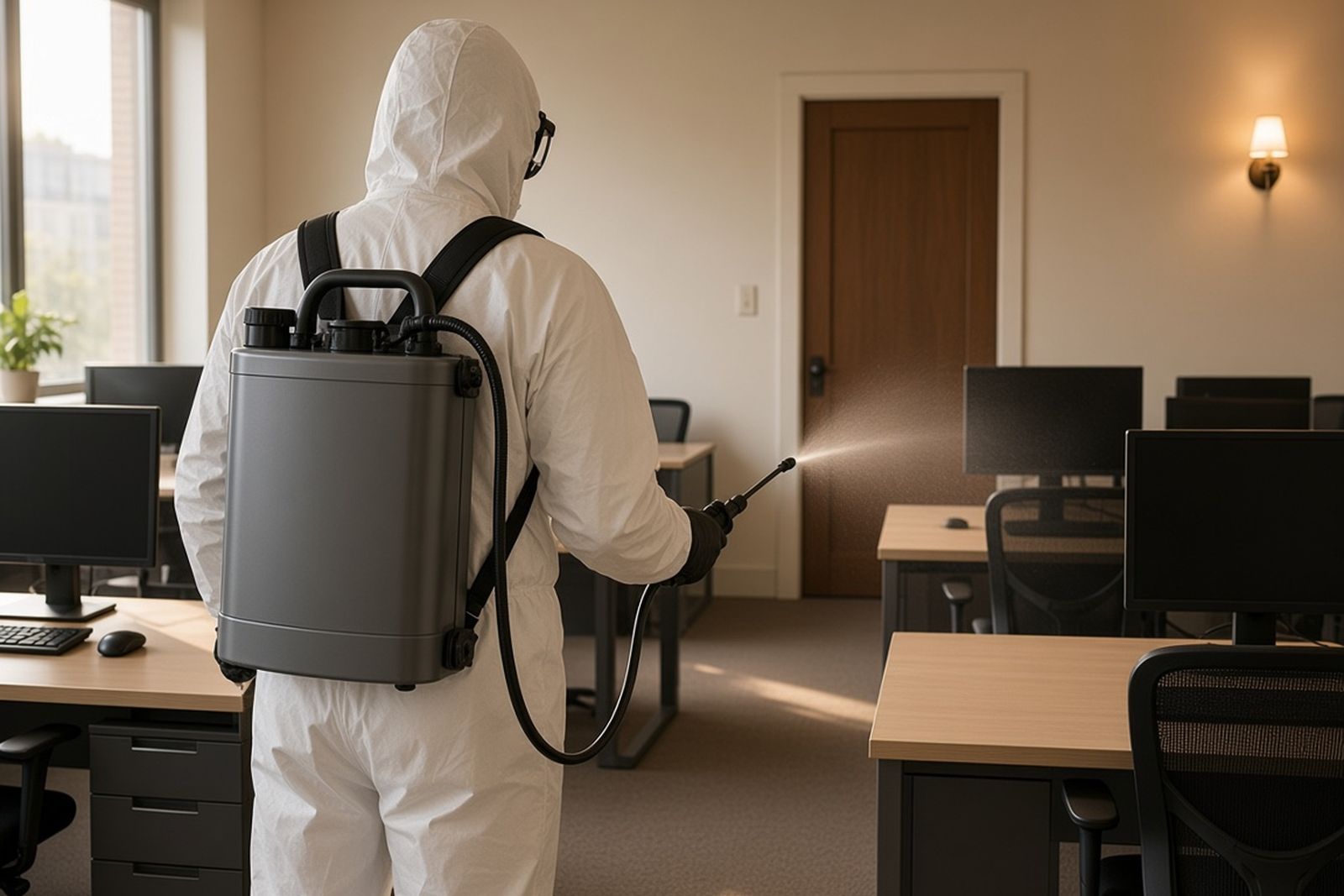
OSHA's general PPE standard requires employers to assess workplace hazards and select suitable equipment. For fogging, the assessment usually points to eye protection, chemical-resistant gloves, and clothing that keeps mist off the skin. Many product labels specify exactly what applicators must wear.
Respiratory protection depends on the product, the method, and the space. Some labels require a respirator during application. Some employers choose respirators even when the label does not, because operators spend extended time in enclosed rooms filled with mist. Once a respirator is required, OSHA's respiratory protection standard applies, with a written program, medical evaluation, fit testing, and training.
Matching protection to the hazard
Respirator choice needs to match the hazard. Particle filters capture droplets but may not stop vapors from some active ingredients. Combination cartridges or other types may be needed. A safety data sheet and the product label are the starting point for that decision.
Skin and eyes deserve as much attention as lungs. Fine mist settles on exposed forearms, necks, and faces, and some active ingredients are corrosive or sensitizing. Goggles rather than open safety glasses, long sleeves or disposable coveralls, and gloves rated for the specific chemical are common choices when the label and safety data sheet point that way.
Do exposure limits apply to disinfectant mists?
OSHA sets permissible exposure limits for many chemicals, and some common disinfectant ingredients and their byproducts are on that list. Those limits cap how much of a substance a worker may breathe over a set period. Employers are responsible for keeping exposures below them.
Staying under a legal limit is not the same as being safe for everyone. NIOSH stated in 2021 that clinically important asthma from airborne disinfectants can occur at exposure concentrations below the occupational limits regulated by OSHA or recommended by NIOSH. That is a strong reason to minimize exposure rather than simply staying under a number.
Minimizing exposure in practice means choosing the right product, applying only as much as needed, keeping people out of treated areas, using ventilation appropriately after the contact time, and wearing proper protection.
People with asthma or other breathing conditions may react to levels that others tolerate. If any of your staff or occupants have these conditions, tell the provider in advance. A careful company will adjust its product choice, its re-entry timing, or both.
Product labels and OSHA rules work together
Disinfectants are registered pesticides, and their labels are legally enforceable under federal pesticide law. Labels specify dilution, contact time, surfaces, application methods, required PPE, and re-entry conditions. OSHA rules work alongside the label; they do not replace it.
Application method is a common issue. Many disinfectants are registered for wiping or trigger spraying but not for fogging. Using a product in a fogger when its label does not allow that method can create compliance problems and may expose workers and occupants to a hazard the product was never tested for.
A careful provider starts every job by checking that the product label covers the target organism, the surfaces, and the application method. It is fair to ask to see that label before work begins.
Ozone and other gas-based treatments
Some services pair fogging with ozone generators or other gas-phase treatments. Ozone is a lung irritant with its own OSHA exposure limit, and treated spaces must be unoccupied during application. Workers who set up and retrieve equipment need a plan to avoid exposure, and nobody should enter until levels have dropped.
The same principle applies to other vapor-phase systems, such as hydrogen peroxide vapor. These can be effective in controlled settings with trained operators and monitoring, but they carry real hazards if rooms are not sealed or re-entry is rushed.
Ask any provider offering these treatments how it monitors levels, how it keeps workers and occupants out, and how it decides when the space is safe to re-enter.
What if my own staff will do the fogging?
Many businesses bought foggers or electrostatic sprayers during recent outbreaks and handed them to custodial staff. If that describes your workplace, it is worth reviewing your obligations.
Your staff need training on each product, access to safety data sheets, the PPE required by the label and your hazard assessment, and a respiratory protection program if respirators are required. You should also have written procedures for when fogging is used, which products are approved, and how rooms are cleared and reopened.
Cleaning first, and caring for the equipment
Remember that fogging does not replace cleaning. Surfaces generally need to be cleaned first so the disinfectant can work. A workplace program that relies on fogging instead of cleaning tends to expose workers to more chemical without delivering better results.
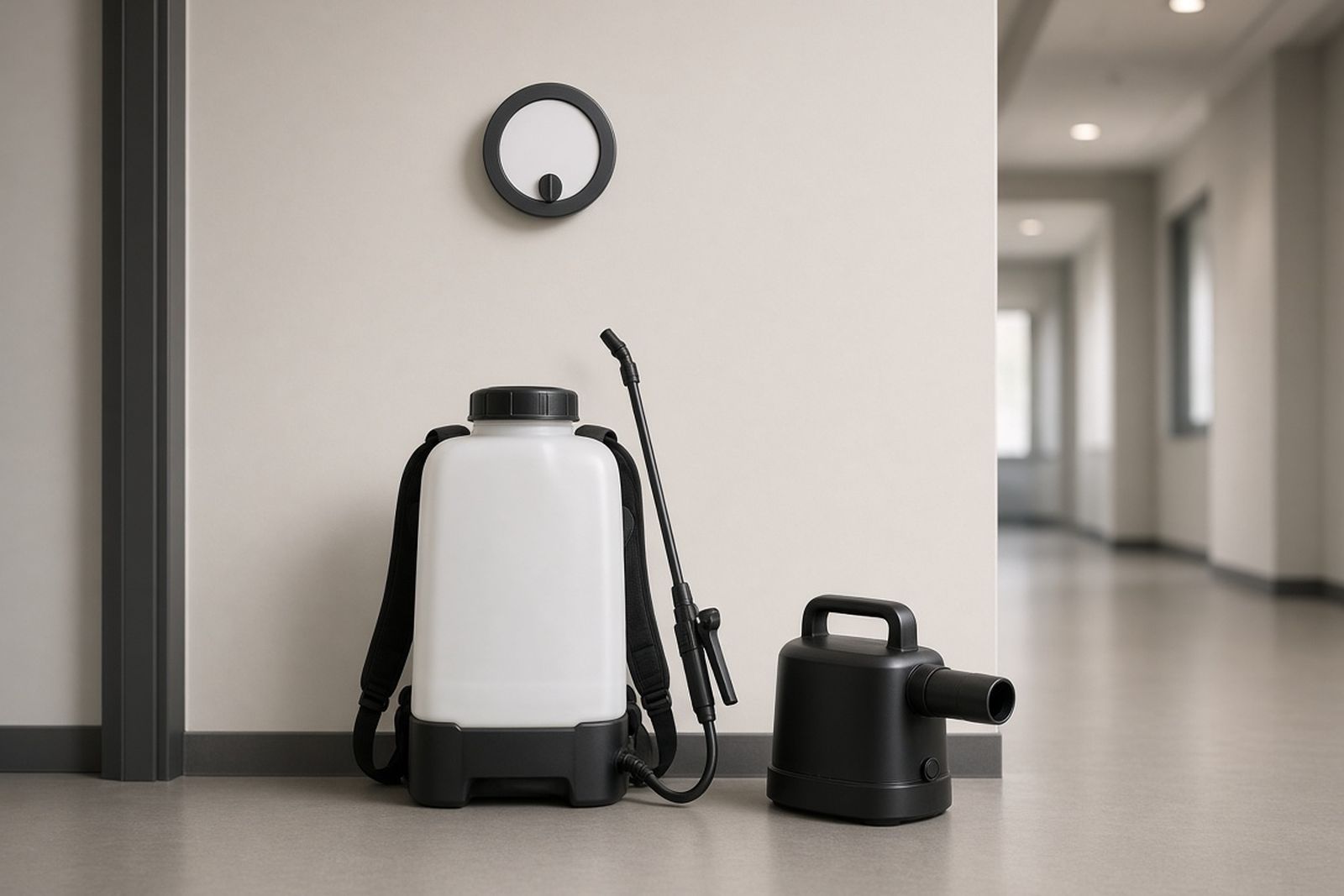
Equipment care is part of the program too. Foggers and sprayers should be cleaned, inspected, and stored according to the manufacturer's instructions, and leftover diluted product should be handled as the label directs rather than left sitting in a tank for the next shift.
Reviewing an in-house nightly spray routine
Plenty of gyms, offices, and schools started nightly electrostatic spraying during a flu season and never revisited it. If a closer runs a sprayer through your building with no mask, or employees have mentioned coughing or headaches after shifts, treat that as the trigger for a review.
Start by pulling the product's label and safety data sheet. Check whether the label lists specific protective equipment for applicators, and whether electrostatic application is among its approved methods at all. Then look for your hazard assessment and training records. If they do not exist, that gap needs closing before the sprayer runs again.
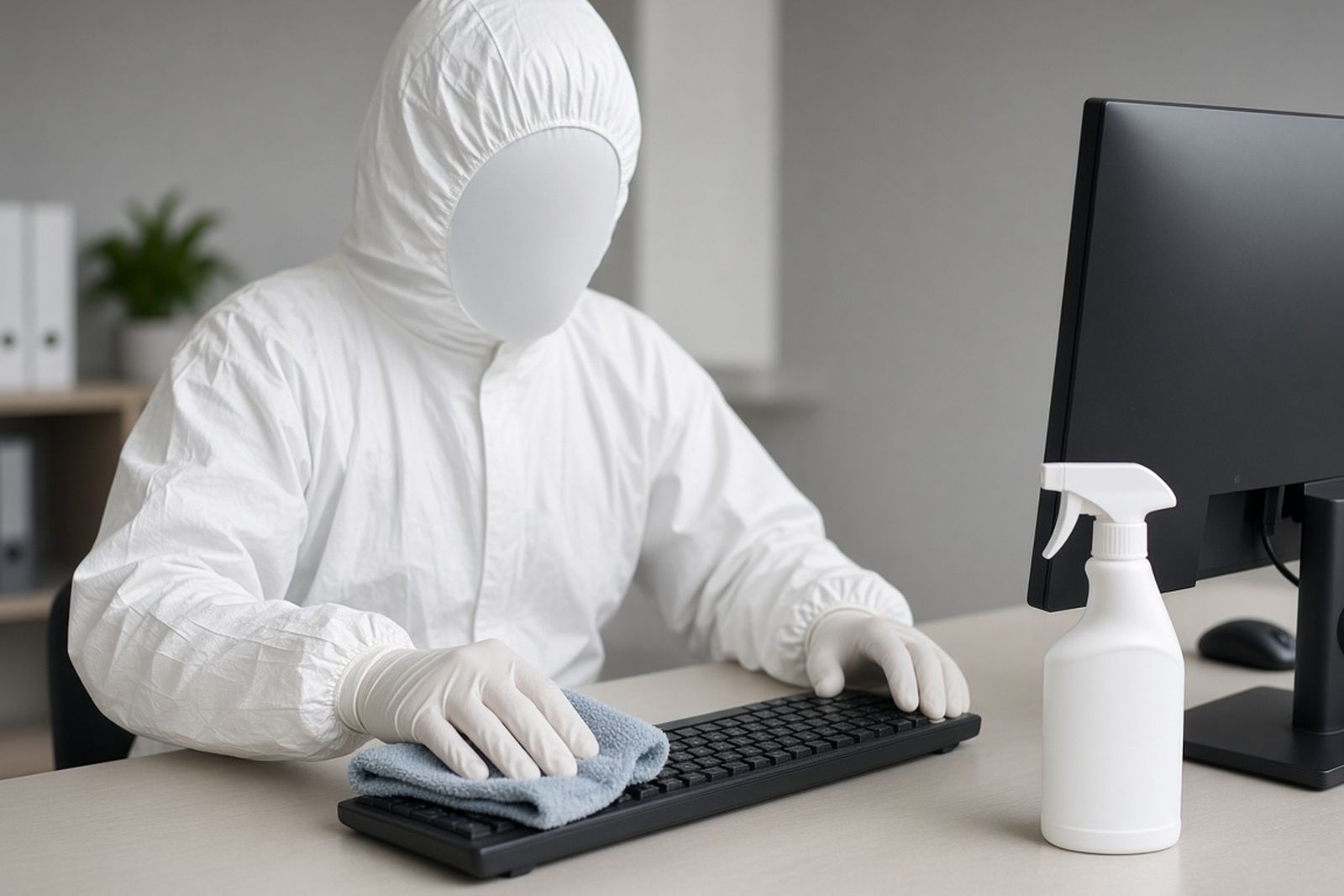
Often the right result is to stop routine spraying. Staff can clean high-touch surfaces with a registered disinfectant wipe labeled for that use, with gloves and training. For the times when broader disinfection is warranted, such as after a reported illness cluster, a provider can use a product labeled for its application method, wear the required PPE, and keep the area closed until the label's re-entry conditions are met.
Compliance questions for a fogging provider
A few questions will show whether a provider takes worker and occupant safety seriously. Listen for specifics about products and procedures rather than general claims.
A provider that answers these clearly is more likely to be applying the right product in the right way, which benefits everyone who uses your building.
Also ask how the provider communicates with the people who use the space. Clear signage on closed rooms, a posted re-entry time, and a contact number for questions help keep staff, tenants, and visitors from walking into a treated area too early.
- What product will you use, and does its label allow fogging or electrostatic application?
- Can I see the label and safety data sheet?
- What PPE do your technicians wear, and are they fit tested for respirators?
- How long must the space stay empty, and how do you decide it is safe to re-enter?
- How do you clean surfaces before disinfecting them?