Knowledge check with explanations

Sanitization & Fogging quiz and study guide

Find out what you already understand, then read the parts you missed.

This quiz tests whether you can tell a sound disinfecting plan from one that just looks impressive. It is for the people who approve or oversee fogging, misting, electrostatic, and UV services. That includes facility directors, school operations staff, and gym and studio owners. It also includes transit and fleet managers, property managers turning over rentals, and office managers who end up holding the vendor contract. The questions focus on mistakes that cost money or put people at risk. One is letting people stay in a room during fogging. Others are fogging over visible dirt, or using a product in a way the label does not allow. Another is running the air units at the wrong time. A last one is treating a nice smell as proof that a room is clean. Every explanation tells you why the safer answer is safer.

Get an email reply about sanitization & fogging

Send a short message to the follow-up inbox. A coordinator can reply by email. This form does not send emergency help; call 911 first if anyone is in danger.

Tell us what you need help with. Share a short description; please leave out medical details, access codes, and other sensitive information.

A request does not confirm a booking. For immediate danger, contact local emergency services.

Or email info@foggingcleanup.online

If you are new to this, read the study guide first. It covers the six ideas the quiz keeps coming back to. First, how to tell when a space truly needs disinfecting, and which dangers fogging cannot fix. Second, who controls the building systems and who must be told before treatment. Third, how to keep mist and product where they belong. Fourth, the difference between cleaning and disinfecting, and why the order matters. Fifth, where product containers and any dirty materials go afterward. Sixth, what a service record must include to be worth anything. The guide will not make you a technician. It will make you much harder to mislead, which is the point. Take the quiz, review what you missed, and take it again.

Sanitization & Fogging knowledge check

15 questions about real sanitization & fogging situations: staying safe, what happens, cost, choosing help and the rules. Every answer comes with a short explanation.

Why this quiz matters

Knowing these basics makes it easier to spot bad advice and ask a company the right questions. This quiz is educational — it does not certify anyone. After the quiz, review the explanations for questions you missed. For professional guidance on your specific situation, use the contact form at the top of the page for an email reply.

Progress1 / 15
ProcessQ1

An office wants a room fogged after a flu outbreak. What should happen before the fogger is turned on?

Study guide: the six ideas behind the questions

Read these before or after the quiz. They cover the concepts every question draws on, written for sanitization & fogging specifically.

1Recognizing what fogging can and cannot address

Fogging, misting, and electrostatic spraying put a disinfectant on surfaces. They are useful after a stomach bug or flu outbreak in a school. They help in a gym with equipment that is hard to wipe by hand. They help in a bus depot where many cabins need treatment in a short time. And they help when turning over a rental after a lung illness. They are the wrong tool for visible dirt, blood, vomit, sewage, mold, rodent droppings, or drug residue. Those need to be physically removed under a different process. These methods also do nothing for air quality once the product settles. A scent afterward tells you nothing about whether germs were killed. Ask what problem a treatment solves. If the answer is general peace of mind, a well-run cleaning program usually does more.

2Authority over the space and the systems

Before any spraying, someone has to decide some things. Who may be in the building? Who controls the air system? Who owns the fire and smoke alarm system? Who will approve letting people back in? In a leased office, that may be the landlord, the tenant, and the building engineer together. In a school, it includes the office staff and the facilities team. In a transit fleet, it includes the maintenance supervisor and perhaps a union safety rep. Companies should not shut off air units, turn off alarms, or fog a shared hallway on their own say-so. Rules vary by state and county. Some settings, like childcare and food service, have their own rules, so check with the local office. Put the chain of approval in writing before the first visit.

3Keeping product where it belongs

Here, walling off an area means controlling where mist and droplets go. Seal the vents in the treated area and close the doors. Shut off or isolate the air units, so the ducts do not carry product to rooms in use or coat filters and coils. Cover or remove food surfaces, electronics, paper, and delicate stock, as the label requires. Electrostatic spraying is more targeted than fogging, but it still drifts. It can leave a film on screens and keyboards. UV-C and ozone require that no one is in the space and that the room is sealed. Ask the company to walk the space with you first. Have them point out what will be covered or removed. Have them explain how they confirm the area is empty before they start.

4Cleaning versus disinfecting and why the order is fixed

Cleaning physically removes dirt, oils, food, and other matter using soap, water, and scrubbing. Disinfecting uses a registered chemical to kill germs left on a cleaned surface. The order cannot be flipped. Dirt shields germs and can weaken the disinfectant. Every EPA-registered product lists a contact time. That is how many minutes a surface must stay visibly wet. Fog or spray that dries too soon has not done its job. Fogging and electrostatic methods only change how the disinfectant gets there. They do not remove the need to clean first or to keep the surface wet long enough. A wipe-and-wait program uses the same chemicals by hand. It is often more reliable on often-touched spots, because a person can see whether the surface stayed wet.

5Where the waste goes

A routine fogging or electrostatic service makes fairly little waste. There are empty product containers, used wipes and cloths, throwaway covers, and the worker's safety gear. Most of it is regular trash. But the product's safety data sheet may list rinsing or disposal steps for containers. Never pour leftover concentrate down a drain without checking the label. Things change when a service follows a mess involving body fluids, mold, or other contamination. Those dirty materials follow regulated paths. The company must handle them apart from the disinfecting step. Rules vary by state and county, so check with the local office. Ask the company how it keeps waste separate when a visit includes both cleanup and disinfecting. Also ask where its containers go.

6Records that prove something happened

A useful service record names the product and its EPA registration number. It lists the dilution, the spray method, and the rooms or vehicles treated. It gives the start and end times and how long surfaces stayed wet. It shows the re-entry time given to the building and the air system steps taken. It also notes what was cleaned first, what was covered or removed, and who approved re-entry. Some buildings add a quick swab test on key surfaces as a cleanliness check. The test shows leftover organic residue, but it does not detect germs. A certificate that just says the building was sanitized, with no details, proves nothing. Keep records in a file that an inspector, insurer, parent, or tenant could review. Compare tickets over time to make sure the work has not quietly shrunk.
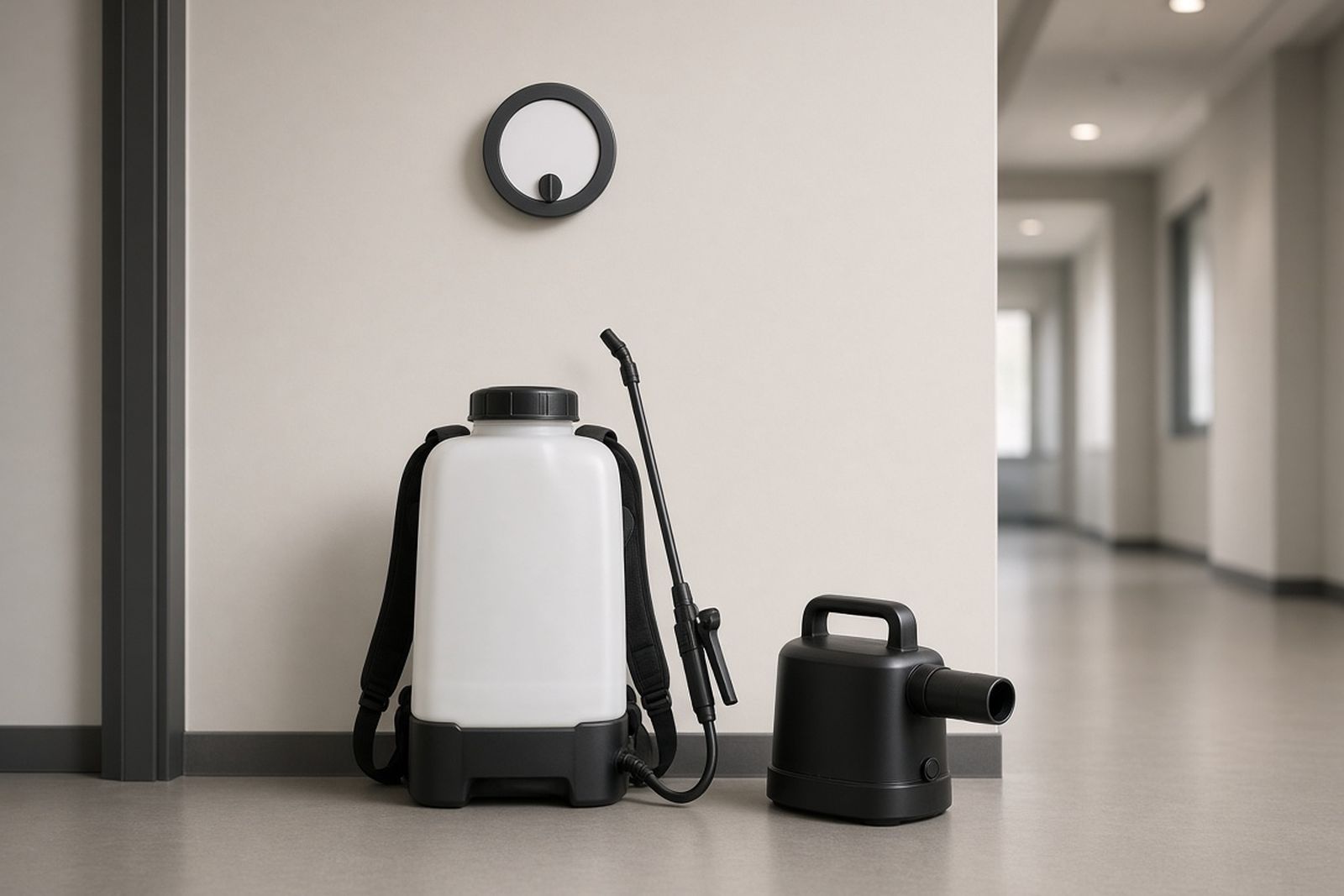
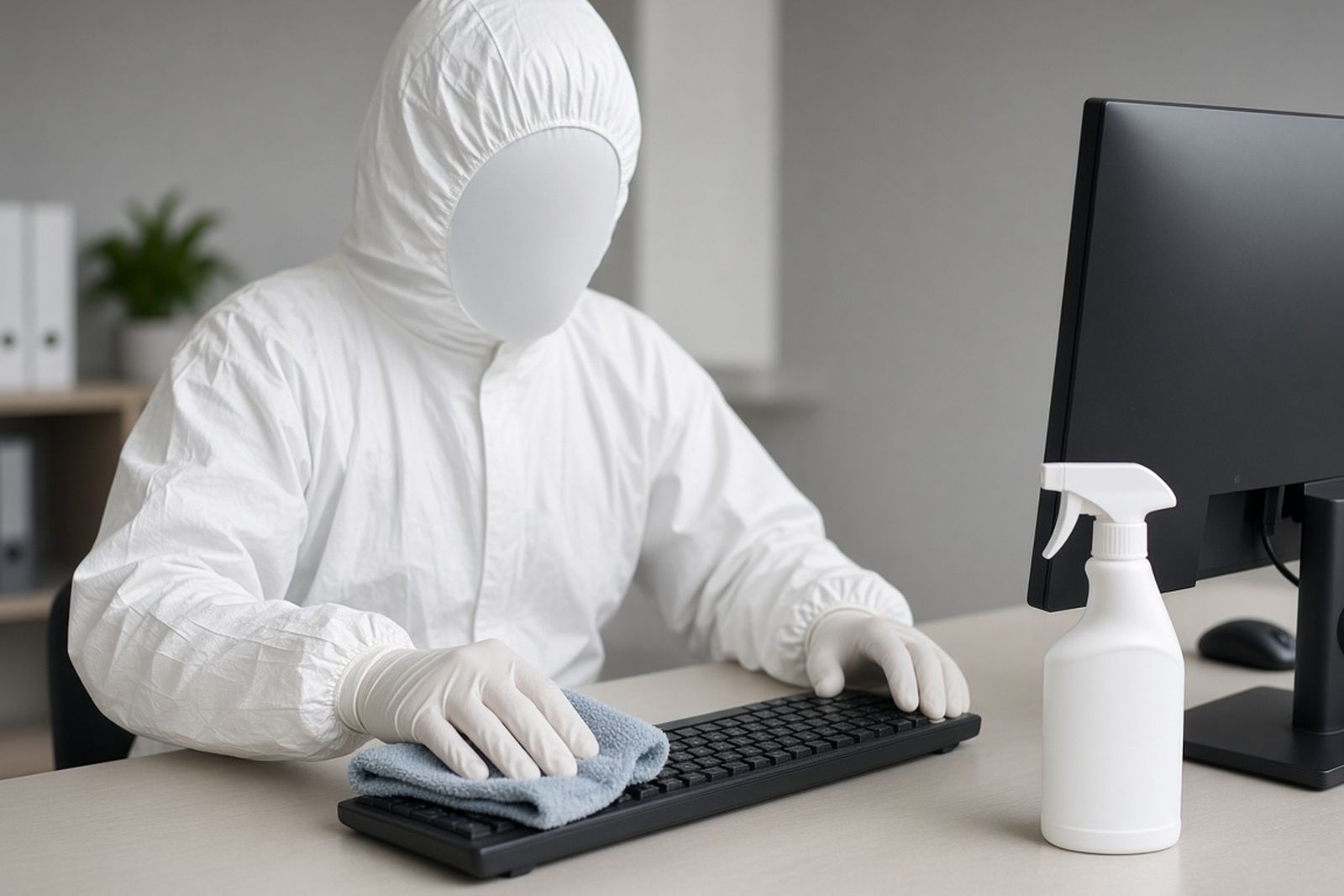
Backpack sprayer and a handheld fogger standing in an office hallway beside a wall timer
Illustrative photo, not a job record. Backpack sprayer and a handheld fogger standing in an office hallway beside a wall timer.

Sanitization & Fogging facts the quiz draws on

8

Products above pH 8 accounted for 74% of failures in the experiment.

Read with care: Accelerated test conditions; not a failure rate for installed equipment.

Source: Jennings et al. (2024)Eight wipe formulations tested on healthcare plastics under fixed strain for seven days.

HR 1.38

Weekly disinfectant use for surface cleaning was associated with a 38% higher rate of new COPD diagnoses among 73,262 U.S. female nurses over six years.

Read with care: Observational study of occupational exposure in healthcare workers; it cannot prove causation or be applied directly to one-time fogging services.

Source: JAMA Network Open (2019)Nurses' Health Study II; 73,262 nurses; 582 incident COPD cases; 2009 to 2015

HR 1.12

Among 61,539 U.S. female nurses followed for six years, weekly disinfectant use showed no significant association with new asthma diagnoses (hazard ratio 1.12, 370 cases).

Read with care: Self-reported exposure and diagnoses; the same cohort found associations with COPD, so the absence of an asthma link is not an all-clear.

Source: American Journal of Industrial Medicine (PMC) (2019)Nurses' Health Study II; 61,539 U.S. female nurses without prior asthma; 2009 to 2015

98.1%

Manual wiping met the study's disinfection-success criterion on 98.1% of surfaces versus 75.5% for UV-C.

Read with care: Specific device, protocol and success criterion; no patient infection endpoint.

Source: Knobling et al. (2023)Naturally contaminated surfaces in a comparative field test.

These figures are public research and agency data, not this network's own job records. Keep each number with its population, year and limits; none of them predicts cost, timing or outcome at a specific property.

Questions about the sanitization & fogging quiz

Do I need to pass the quiz before hiring a fogging provider?

No. The quiz is a self-check, not a license. Its value is in helping you ask better questions. It also helps you spot a proposal that skips cleaning first, ignores the label, or offers to fog while people are in the room. A high score means you understand the choice. It does not mean you should run the equipment or mix products yourself.

Why does the quiz spend so much time on product labels?

Because the label is the law for a registered disinfectant under FIFRA, the federal pesticide law. It is also where most fogging programs quietly go wrong. If a product is not registered for fogging or electrostatic use, using it that way may break the rules. It may also fail to kill the germs it claims to kill. Two questions ask you to spot that mismatch. It is the single most useful thing a buyer can check.

Does the quiz cover buses and other vehicles?

Yes. Vehicle cabins have short turnaround times, closed-in air, electronics in the dashboard, and fabric seats that soak up product. The questions ask you to weigh those things against the benefits of electrostatic spraying. They also ask you to spot when a daily wiping routine on handrails and seat backs works better. That is often the case on vehicles.

Is there a question about ozone?

There is. Ozone machines are sometimes sold as chemical-free cleaners. The quiz asks you to name when they are dangerous, which includes any space with people in it. It also asks which materials they can damage. The explanation makes clear that ozone is not a routine disinfectant for offices, gyms, schools, or rentals. It is a narrow tool with real risks.

Can I use the quiz to train custodial or facilities staff?

It works well for that. Have staff take it on their own, then talk through the questions the group missed. Common gaps include the order of cleaning and disinfecting and what contact time means in practice. Another is who is allowed to turn the air units back on after a treatment. Those talks usually improve procedures more than the score itself does.

What if my state has stricter rules than the quiz describes?

Follow your state and local rules. The quiz describes widely accepted practice and points to the product label. But limits on who can be present, childcare and food service rules, and duties to notify people vary by state and county. Check with the local office whenever the quiz and your local rules seem to differ. Then write the local rule into your own procedures.

How does the quiz treat UV-C?

As an extra method with a clear weakness. It only affects surfaces the light shines on directly. Shadows, the undersides of objects, and anything behind a divider are untouched. The questions ask you to spot that limit. They ask you to pair UV-C with cleaning and liquid disinfectant on often-touched spots. Do not treat a single pass as if it cleaned the whole room.

What other visitors think

Poll results

Every count is a real visitor vote; nothing is seeded or padded. One vote per poll per device, and you can change your answer.

Your experience

A vendor offers to fog your classrooms at lunch while students are outside. What do you say?

No visitor votes yet
Industry

How do you see repeat fogging contracts today?

No visitor votes yet