Short answer
A fogging plan you can defend starts with a clear reason. You confirm the product label allows the method. You make cleaning a required first step. You treat only the spaces that matter, and you set the time for going back in from the label. This example follows a hypothetical school after a cluster of stomach illness. It shows how you write down each choice so you can explain and adjust your plan later.
Why follow one school's response from start to finish?
Fogging choices are often made fast and under pressure. A parent emails. A staff member calls in sick. A vendor offers a visit that same week. A contract is signed before anyone asks what problem it solves. This example slows that down, so you can see each choice on its own.
The school, the people, and the events described here are hypothetical. They are blended from common cases for teaching. They do not describe any real customer, outcome, or price. Your building, your local health authority, and your product labels will shape your own choices.
Watch for two threads as you read. The first is the product label, which keeps showing up as the paper that decides things. The second is the order of steps: clean first, then disinfect, then check, then write it down. When either thread breaks, your written work plan loses its footing.
The cluster, and the first decision
In this hypothetical, a small charter school with about two hundred students sees a cluster of vomiting and diarrhea over three days. Most cases are in two classrooms that share a restroom. The principal tells the county health department. It advises extra cleaning and disinfecting with a product that works against norovirus. It also advises keeping sick students and staff at home.
Norovirus is a sensible worry. The CDC, in its 2024 facts and figures, estimates that norovirus causes 19 to 21 million illnesses and about 2,500 reported outbreaks in the United States each year. It spreads easily in places where young children share surfaces.
The first decision is not about fogging at all. The principal asks her facilities lead to write down the exact goal. It is to lower the chance of more spread through dirty surfaces in the affected classrooms, the shared restroom, and the cafeteria over the next two weeks. That sentence becomes the anchor for everything else. You can write the same kind of sentence for your own building.
The label decides the method
A local vendor offers to fog the whole school each night. Before answering, the facilities lead asks for the product name and registration number. A disinfectant should only be fogged or sprayed if its label gives directions for that method.
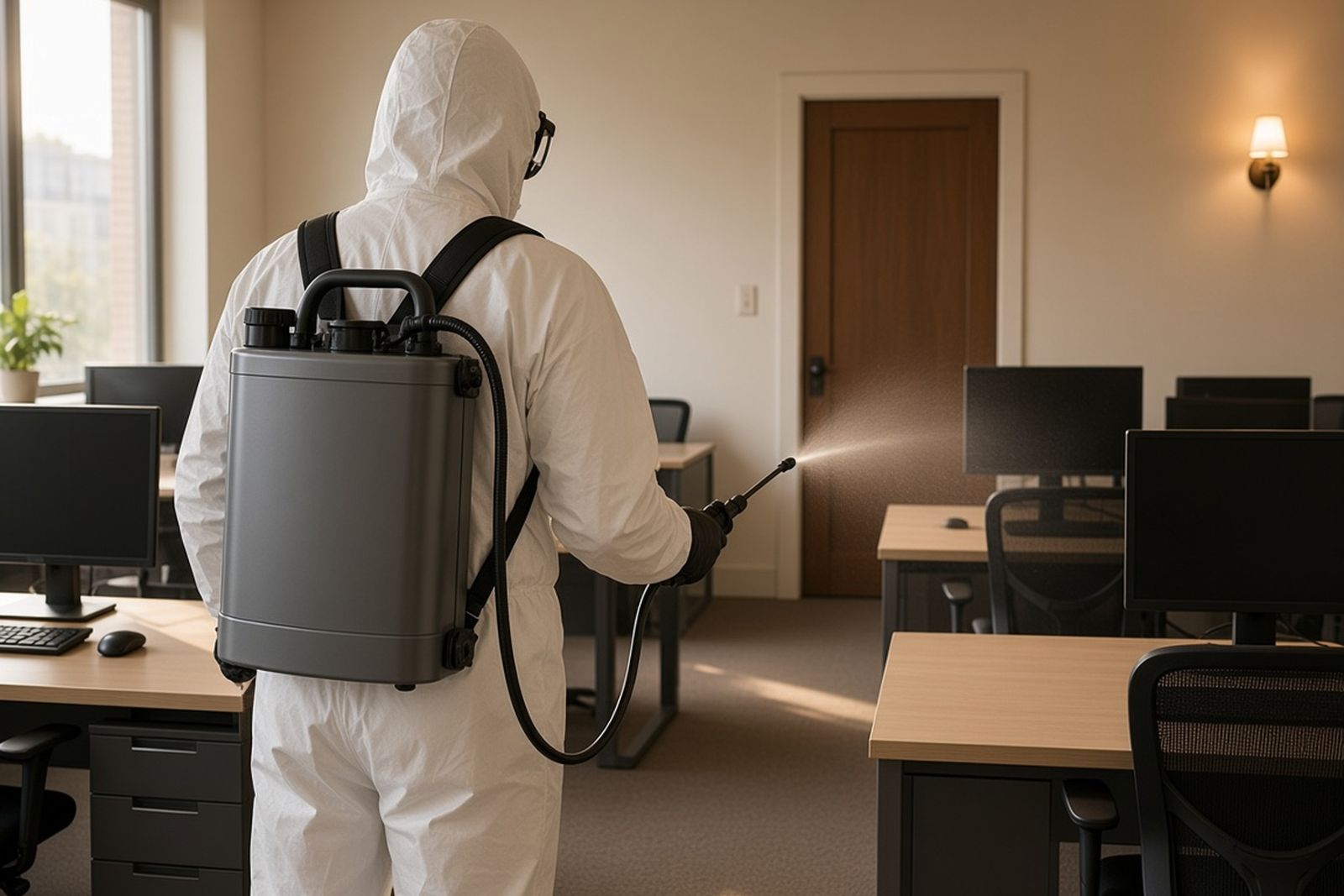
The vendor's first product lists norovirus but has no directions for fogging. The vendor then offers a second product. Its label gives directions for electrostatic spraying and lists norovirus. It states how long surfaces must stay wet, how to air out the rooms, and how long to wait before going back in. The facilities lead accepts the second product and says no to fogging with the first.
This one exchange removes most of the risk from the project. It makes sure the germ-killing claim applies to the method in use. It also gives the school a clear reason it can point to if parents or staff ask. You can ask your own vendor for the same four things.
- The product lists the germ you are worried about.
- The label gives directions for the planned method.
- The wet time, airing out, and re-entry time are stated.
- The directions for surfaces that touch food are noted for the cafeteria.
Choosing zones to treat, not the whole building
Treating the whole building sounds thorough. But it spreads the effort thin and exposes more people to chemicals. So the facilities lead maps where the sick students spent their time and which surfaces they shared. The list is the two affected classrooms, their shared restroom, the nearest hallway drinking fountain, and the cafeteria.
Offices, the library, and classrooms in the other wing get no electrostatic spraying. They stay on the normal nightly cleaning routine, with extra care for door handles and light switches. The plan says any change to these zones needs the principal's written approval.
Choosing zones this way puts the care where the risk really is. It also makes the evening schedule realistic. The vendor's workers can move carefully through five areas and not rush through twenty.
The map itself goes into the file. It is a simple floor plan with the treated zones shaded, attached to the work order. It prevents confusion when a fill-in worker arrives on a later night and wonders if the music room is included. It also makes it easy to show parents or the health department exactly where treatment took place. A map like this would do the same for you.
Cleaning written into the plan
The plan makes the school's own cleaning team responsible for cleaning every often-touched surface in the zones before the vendor arrives. That includes desks, chairs, cubbies, door handles, faucets, toilet flush handles, stall latches, fountain buttons, and cafeteria tables. Any mess from a sick child is cleaned up promptly during the day, following the school's body fluid steps. It is not left for the evening.
The vendor's worker walks each zone before spraying and flags anything that looks unclean. Flagged surfaces are cleaned again before spraying. The vendor's report records which surfaces were flagged.
This part of the plan matters for two reasons. Disinfectants work less well on dirty surfaces. And it prevents a common failure, where each side assumes the other did the cleaning. Your plan should name who cleans, too.
A nightly sign-off sheet
The cleaning supervisor also gets a short sign-off sheet for each evening. It lists the surfaces in each zone, with a box to initial once they are cleaned. The vendor's worker reviews the sheet on arrival. It is a small piece of paper. But it turns an assumption into a record. It gives both teams one thing to point to if something is questioned later.
Coverage and wet time
Electrostatic sprayers are sometimes sold as reaching every hidden side of an object. The facilities lead has doubts. Droplets land mostly on the surfaces the nozzle faces. The far side of a chair leg or desk edge is easy to miss.
So the plan requires the worker to come at often-touched objects from more than one side. That includes the undersides of desk edges and the backs of chair frames that children grip. It also requires the worker to confirm that treated surfaces stay visibly wet for the contact time on the label, and to spray again where they dry early.
The air handler for the treated wing is set to the mode the vendor and building engineer agree on for the spraying period. The setting follows the label's directions for airflow. Anything tied to fire and safety systems is checked with the fire marshal and the alarm contractor before it is changed.
Going back in, and telling people
Each evening, the vendor finishes spraying early enough for the label's re-entry rules to be met before the cleaning staff return in the morning. The cafeteria surfaces that touch food get whatever follow-up step the label requires before breakfast is served.
Parents get a short letter. It explains that the school is working with the health department. It says certain areas are being cleaned and then disinfected with a product labeled for norovirus. It says treatment happens after hours and rooms are aired out before students arrive. The letter names a contact person for questions and invites families with health concerns to reach out.
Staff get a separate note that asks them not to enter treated areas after hours and explains why. The cleaning team is briefed on the product's safety data sheet, the maker's fact sheet on its hazards.
A family's concern, handled in writing
One family writes back to say their child has asthma and is anxious about chemical smells in the classroom. The principal answers in person. She explains the airing-out step and the wait before re-entry. As an extra safeguard, she offers to have the child's desk and chair wiped with a detergent solution each morning before class. That talk is noted in the file, along with what was offered.
Wrapping up, and ending the service on purpose
The vendor sends a report after each visit. It lists the zones, times, product, worker, flagged surfaces, and any problems. After two weeks with no new cases reported to the health department, the principal ends the electrostatic service. The affected areas go back to the normal cleaning routine with an updated checklist.
The facilities lead writes a one-page summary. It says why the service was used, which product and method, which zones, how long, and what changed in the routine afterward. That summary sits in the school's facilities file, ready for the next time a similar question comes up.
Ending the service on purpose is part of a plan you can defend. A service justified by one event should stop when the event is over, unless you write down a new reason.
- Reports from each visit, filed with your facilities records.
- A set end date tied to the first goal.
- A summary that explains your choices for later.
- An updated routine cleaning checklist for the affected areas.
What can you borrow for your own building?
Write your goal in one sentence. Get the label before you approve the proposal. Treat zones, not buildings. Put cleaning in your written work plan with a named owner. Ask how coverage and wet time will be confirmed. Set re-entry from the label. Tell people plainly what you are doing. End the service on purpose.
None of these steps calls for special equipment on your side. You only need to ask a few pointed questions and write the answers down. That record lets you explain your choices to a board, a parent, an inspector, or a tenant. It also lets you do better the next time.
If your building has never faced this kind of event, think about drafting a short template now. Make a blank version of the goal statement, zone map, cleaning sign-off, and closing summary. It takes you an hour to prepare. It can save you a great deal of confusion when the phone starts ringing.