Short answer
Sanitization and fogging services often happen during stressful moments: an illness in the household, an outbreak at work, or worried customers. Owners may feel fear of spreading germs, anxiety about chemicals, guilt, and frustration with closures. You can ease the strain by getting clear product and re-entry information, planning the disruption, communicating calmly with others, and avoiding anxiety-driven overcleaning with risky chemical mixtures.
Why a disinfection visit feels so stressful
Most people do not call a fogging or sanitization company on an ordinary day. They call after a family member has been sick, after several employees go home ill, after a customer complains, or after a frightening diagnosis in the household. The service arrives in the middle of worry, not before it.
That worry often has two sides. You are afraid of germs spreading to someone vulnerable, such as a newborn, an older parent, or a coworker with a weakened immune system. At the same time, you may be uneasy about spraying chemicals through the place where you live or work.
Feeling pulled in both directions is normal. The aim is not to eliminate every concern but to get enough clear information that you can make a decision and then let yourself rest.
There is often a third layer as well: cost and time. Paying for a service you did not plan for, taking a day off work, or closing a shop for an afternoon all add pressure at a moment when your energy is already low. Acknowledging that pressure honestly makes it easier to plan around it.
Is your worry proportionate?
Some illnesses do spread easily through households and shared spaces. Norovirus is a good example. CDC reported in 2024 that norovirus causes 19 to 21 million illnesses, about 2,500 reported outbreaks, 109,000 hospitalizations, and 900 deaths in the United States each year. Being cautious after a stomach bug is reasonable.
It also helps to remember that most spread happens through close contact and frequently touched surfaces, and that careful handwashing, isolating sick people when possible, and targeted cleaning of high-touch areas do much of the work. Whole-building fogging is sometimes useful, but it is not the only line of defense.
If you are unsure how worried to be, talk with your doctor or local health department about the specific illness. Clear guidance about how it spreads often calms fear more effectively than any product.
Try to notice when worry is being driven by a single frightening story rather than by your actual situation. Asking yourself who in your home is truly at higher risk, and what the illness really requires, can bring the problem back to a manageable size.
What if you are anxious about the chemicals themselves?
Many people feel uneasy about disinfectant fog, especially if someone at home has asthma, allergies, or chemical sensitivities. Those concerns deserve a direct answer rather than reassurance alone.
Ask the provider for the product name, its EPA registration number, the label, and the safety data sheet before the visit. Ask who needs to leave, how long the space must stay empty, and how it will be ventilated before you return. If someone in the home has a health condition, share the product information with their doctor.
Knowing exactly what is being used, and how long to wait, turns a vague fear into a concrete plan. Many people find that once they have read the label and asked their questions, the anxiety drops noticeably.
- The exact product being applied, plus its EPA registration number.
- Label directions, including the application method.
- Safety data sheet.
- Who must leave, and the re-entry time.
- Ventilation plan after treatment.
- What to do with food, dishes, toys, and pets.
Avoiding overcleaning out of fear
Anxiety about germs can push people toward risky habits. They mix products, spray disinfectant on skin or food, or clean with strong chemicals in small rooms without ventilation. These choices can cause real harm.
The impulse was widespread early in the pandemic, when fear was high, and it can reappear whenever illness enters a home.
If you notice yourself cleaning compulsively, reapplying disinfectant again and again, or mixing products to make them stronger, pause. Follow product labels, never combine bleach with ammonia, vinegar, or other cleaners, and remember that more chemical is not the same as more protection.
Leaving home for the treatment
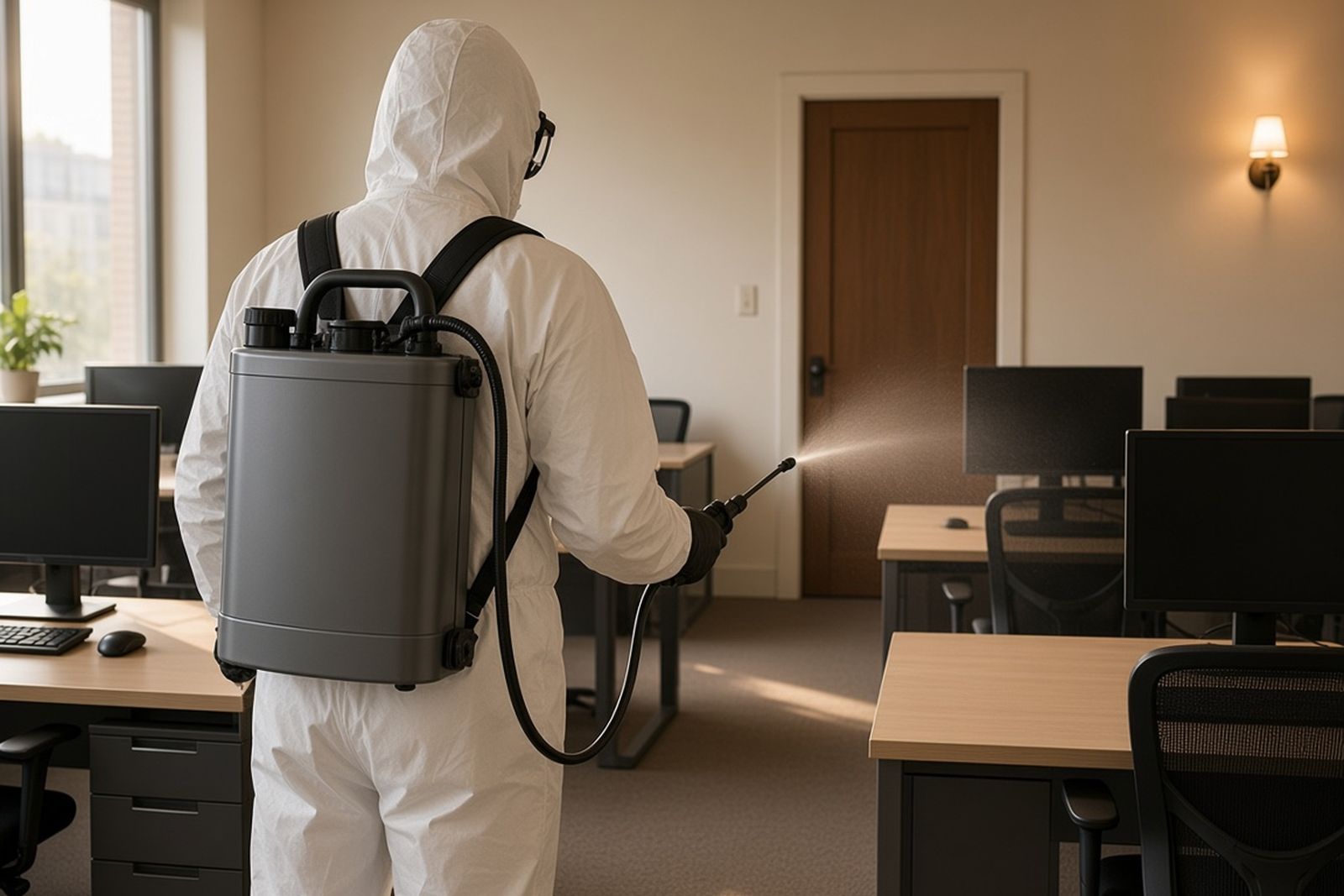
Fogging usually requires the space to be empty during application and for a period afterward. For a household, that can mean packing up children and pets, finding somewhere to go, and waiting. After an illness, when everyone is tired, that disruption can feel like one more burden.
Planning helps. Ask the provider for an exact schedule, including arrival time, application time, and when you can return. Pack what you need for the waiting period, such as medications, snacks, chargers, and comfort items for children. Arrange for pets to be cared for away from the home.
When you return, open windows if the provider recommends it, wash any dishes or toys that were left out, and give yourself permission to take the rest of the day slowly.
Children may have questions about why they cannot go home for a while. A simple explanation works well: the house is getting a special cleaning to help everyone stay healthy, and it needs a few hours to be ready. Framing it as care rather than danger keeps them from absorbing your anxiety.
Closures, customers, and staff
For business owners, the stress often centers on closures, lost revenue, and what customers will think. Customers do pay attention. In a September 2020 Ipsos poll of 1,005 US adults for the American Cleaning Institute, 77% expected businesses to wipe down surfaces frequently, and 65% felt businesses were cleaning enough.
Scheduling fogging after hours or on a closed day limits disruption. Clear, calm communication with staff and customers usually helps more than silence. A short note that explains the cleaning and disinfection steps taken, without alarming language, tends to build confidence.
If you run a restaurant, school, care facility, or similar business, ask your local health department or licensing agency whether any reporting or closure requirements apply to an illness outbreak. Knowing the rules early lets you plan rather than react.
Staff deserve the same consideration. Employees who were sick may feel embarrassed, and those who stayed healthy may be nervous. A brief team conversation about what was done, and a reminder about staying home when ill, usually does more for morale than any product.
A family after a stomach virus
The following composite example is illustrative. A family of five has a stomach virus move through the house over a week. The youngest child is an infant, and the grandparents who help with childcare are in their seventies. The parents feel exhausted, guilty, and determined to make the house safe before the grandparents visit again.
The parents first clean the bathrooms and the areas where family members were sick, following the labels on their products. They then call a sanitization company to treat the rest of the house. The company sends the product label and safety data sheet, explains that the family must be out for several hours, and asks them to remove the baby's bottles and toys.
The family spends the afternoon at a park and a relative's house. When they return, the house is aired out, and the provider leaves a short record of what was treated. The parents share the product information with their pediatrician, who reassures them. That night, for the first time in a week, they sleep without lying awake worrying about the next round of illness.
Easing guilt, and knowing when to look for more support
After an illness spreads, people often look for someone to blame, including themselves. Parents wonder if they should have kept a sick child home sooner. Managers wonder if they should have sent an employee home earlier. Those thoughts are natural, but they rarely help.
Most contagious illnesses spread before anyone realizes what is happening. Doing a thorough cleanup now, and adjusting habits for next time, is a responsible response. It is not an admission of failure.
If tension builds between family members or coworkers, try to shift the conversation toward practical questions: what to clean, how to support anyone still sick, and what small changes could reduce spread in the future.
For most people, stress fades once the illness passes and the space is treated. For some, especially those with existing anxiety or contamination fears, the worry may linger. You might keep cleaning long after it is necessary or avoid parts of your home.
If fear of germs is disrupting sleep, work, or relationships, talk with a primary care provider or counselor. Support can help you return to routines that feel safe without being consumed by worry.
Remember that you took reasonable steps to protect the people around you. Asking good questions, following label directions, and giving your household time to recover are the actions that matter most. Once those are done, it is fine to let yourself stop scanning every surface.