Short answer
Before you approve fogging or electrostatic spraying at a property you manage, confirm the product label allows that application method, decide which spaces are actually at risk, plan resident notice and re-entry, and make sure surfaces are cleaned first. Fogging supplements cleaning; it does not replace it. A clear written scope and a label-based re-entry plan protect residents, staff, and your budget.
Why you are being offered fogging in the first place
Fogging proposals usually arrive after something has gone wrong or feels uncertain: a norovirus cluster in an assisted living wing, a flu wave in an office tower, a resident complaint about a dirty gym, or an owner who wants to look proactive. Vendors respond with an attractive pitch that promises broad coverage in very little time.
Your job is to translate that pitch into a decision about risk. Ask yourself what problem you are trying to solve, which surfaces people actually touch, and whether a better cleaning routine would address the concern more directly. A fog that rolls through an empty lobby is visible and reassuring, but visibility is not the same as effectiveness.
Start by writing down the reason for the service in one sentence. If that sentence is vague, such as "general sanitation," you are likely paying for optics. If it is specific, such as "reduce contamination in a shared laundry room after a reported stomach illness," you can judge whether fogging fits.
What the product label has to say
The label is the controlling document for any disinfectant used on your property. If the label does not include directions for fogging or electrostatic spraying, the product should not be applied that way, and that single point should shape every conversation with a vendor.
Ask for the product name and EPA registration number before work is scheduled. Then look at the label yourself or have the vendor highlight the relevant sections. You are looking for application directions that mention the method they plan to use, the dilution, the required contact time, and any restrictions on occupied spaces, food-contact surfaces, or ventilation.
If the label is silent about fogging or electrostatic application, the vendor should explain why they plan to use it that way. A confident answer without label support is a red flag.
- The exact product and its EPA registration number, in writing.
- Label directions for the specific application method.
- Contact time for the organisms you care about.
- Re-entry, ventilation, and occupancy restrictions.
- Food-contact and sensitive-surface warnings.
Does fogging replace your janitorial program?
No. Soil, grease, and residue shield microorganisms and can weaken disinfectants. That is why cleaning must come first, with detergent and friction on the surfaces people touch. Only then does a disinfectant, however it is applied, have a fair chance.
Automated and no-touch methods tend to disappoint when they are asked to do the work of cleaning.
For most properties, the strongest program is a reliable cleaning routine for high-touch surfaces, with fogging or electrostatic spraying used selectively for specific events. Budget for the routine first.
Residents, staff, and building systems
Chemical application in shared spaces affects people who never signed the vendor contract. Residents with asthma, chemical sensitivities, pets, or young children may have strong concerns. Commercial tenants may have employees who need advance notice for health reasons.
Give written notice that names the areas to be treated, the date and window, the product, and when people can return. Post the same information at entrances to the treated area. Include a contact person who can answer questions. If a resident or tenant raises a medical concern, take it seriously and discuss alternatives, such as treating their adjacent spaces with wiping instead.
Your own staff also need protection, since maintenance and janitorial workers are the people most likely to breathe what is applied. Make sure your maintenance and janitorial teams know when fogging is scheduled and do not walk into a treated space before it is cleared.
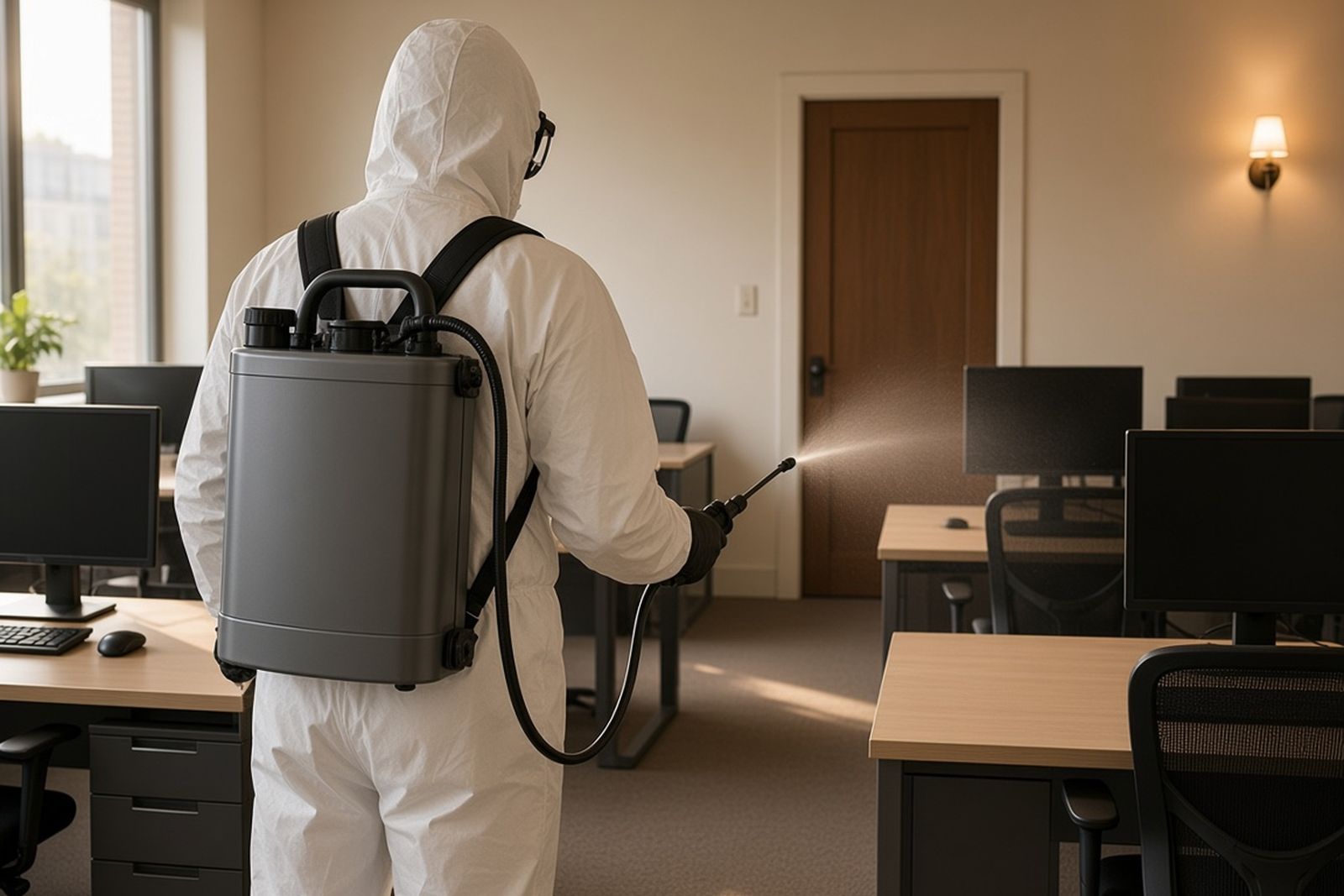
Fine droplets move with air. If your air handlers are running, mist can spread into corridors, other suites, or occupied units. Vendors often ask to shut down or isolate air handling in the treated zone during application and for part of the dwell period. Coordinate this with your building engineer so you do not disrupt other systems.
Some fogging methods can trigger smoke or fire detection devices. Your vendor should explain whether their method is likely to do so and what precautions they recommend. Any decision to cover or bypass life-safety devices should follow your fire alarm contractor's guidance and local fire code. Check with the fire marshal and your alarm provider before anything is disabled.
Sensitive electronics, artwork, fabrics, and certain finishes can react poorly to some products. Walk the space with the vendor ahead of time and decide what should be covered, moved, or excluded.
Example: a senior apartment community after an outbreak
Here is how that can look in practice, using an illustrative property. You manage a senior apartment community with a shared dining room, a library, and a fitness room. After several residents report gastrointestinal illness in the same week, the local health department recommends enhanced cleaning of common areas. An owner representative forwards you a proposal for building-wide fogging every night for two weeks.
Before approving it, you ask the vendor for the product label. It lists a relevant organism, includes directions for electrostatic application, and requires a specific contact time and ventilation period. You narrow the scope to the dining room, restrooms near it, and the library, since those are the spaces the health department mentioned.
Your janitorial team cleans high-touch surfaces first each evening. The vendor then applies the product after the dining room closes, with the air handler for that zone paused. Residents receive notice, and the library opens the next morning only after the vendor confirms the label re-entry conditions are met. The owner representative receives a short report with the product, areas, times, and contact-time confirmation for each visit.
Contracts, closeout reports, and comparing proposals
Your contract should name the areas, the product and registration number, the application method, the frequency, the pre-cleaning responsibility, and the re-entry criteria. It should say who on your side can approve changes, and it should require the vendor to carry appropriate insurance and follow label directions.
Ask for a service report after each visit. It should list the date, the start and end times, the areas treated, the product and dilution, the technician's name, and any issues, such as a surface that could not be treated or a space that was occupied. Keep these reports with your maintenance records.
If a vendor offers testing, understand what it measures. Surface swabs or ATP readings can show whether a surface was cleaned, but they do not prove the absence of a specific pathogen. Ask how results will be used to change the program, not just to decorate a report.
Proposals are hard to compare when one vendor quotes by square foot, another by visit, and a third by building. Put them on the same footing by asking each vendor to answer the same short list of questions in writing. The goal is to see what you are actually buying, not just the bottom line.
Ask who performs the pre-cleaning and whether it is included. Ask how many technicians will be on site, how long each area is expected to take, and how the vendor verifies that surfaces stayed wet for the label contact time. Ask what happens if a treated space is accidentally entered early. Ask for a sample service report from a similar property, with client details removed.
Pay attention to how each vendor talks about limits. A provider who readily explains what fogging cannot do, and who suggests a narrower scope when a broad one is not justified, is usually more trustworthy than one who promises that a single mist will handle everything. That candor is worth more than a lower per-visit figure.
Once you choose, schedule a short review after the first few visits. Walk a treated area with the vendor, read the service reports together, and adjust the plan while it is still easy to change.
- Areas, frequency, and application method.
- Product, registration number, and dilution.
- Who performs pre-cleaning, and to what standard.
- Re-entry criteria and who confirms them.
- Per-visit service reports.
When is fogging the wrong answer?
Fogging is a poor fit when the space is occupied and cannot be cleared, when the label does not support the method, when surfaces have not been cleaned, or when the concern is really odor, mold, or pests. Those problems need their own diagnosis and treatment.
It is also a poor fit when it becomes a substitute for fixing an underlying issue. Water intrusion, sewage backups, or neglected restrooms will keep generating complaints no matter how often a mist is applied. Spend the money on the repair first.
Finally, be wary of recurring contracts that were justified by a single event. Reassess after the event passes. If the original reason no longer applies, your cleaning program alone may be enough, and your residents and staff will breathe easier with fewer chemicals in the air.