Short answer
To evaluate equipment proposed for sanitization and fogging, match each device to a documented purpose. Check that the disinfectant label permits the application method, that the sprayer's droplet size suits your surfaces, that pre-cleaning tools are included, that respiratory protection and re-entry plans cover occupants and staff, and that the provider can verify results with a method such as ATP testing rather than relying on how the mist looks.
The plan matters more than the machine
Fogging proposals often lead with equipment: a new electrostatic sprayer, a hospital-grade fogger, a UV robot. Photos of mist drifting across a gym or a lamp glowing in an empty classroom can be persuasive. But a machine is only as good as the product it applies, the surfaces it reaches, and the steps before and after.
When you evaluate equipment, try to connect each device to a job it performs. What surfaces will it treat? What product will it apply? How will anyone know it worked? A provider who can answer those questions clearly is offering a plan. One who talks mostly about the machine's features is offering a product demonstration.
The sections below walk through the main types of equipment you may see in a proposal and the questions that help you decide whether they fit your building.
Foggers vs electrostatic sprayers
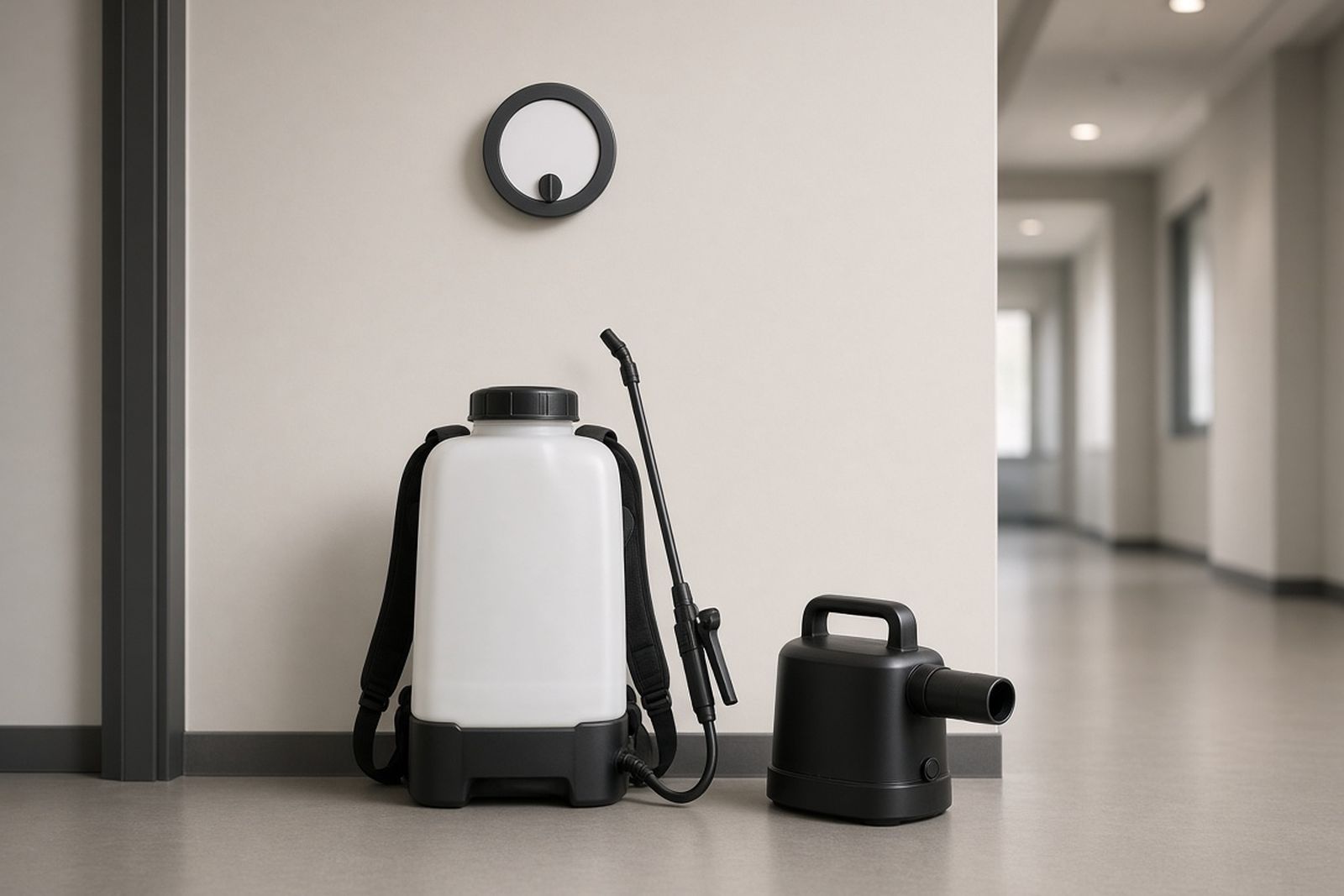
Ultra-low-volume foggers, sometimes called cold foggers, break liquid into fine droplets and push them into the air, where they drift and settle. Thermal foggers use heat to create an even finer fog. Electrostatic sprayers produce somewhat larger droplets and give them an electric charge so they are drawn toward surfaces.
Each has trade-offs. Finer droplets travel farther but may evaporate or stay airborne longer, raising inhalation concerns and leaving less liquid on surfaces. Larger droplets land more reliably and keep surfaces wetter, but they do not drift as far and require the operator to aim carefully. Electrostatic charge helps with edges and some hidden sides but does not guarantee full coverage.
Ask what droplet size the equipment produces, why that size suits your space, and how the operator ensures coverage on high-touch surfaces. Also ask whether the product label specifically permits application with that type of device.
Maintenance and calibration matter as well. Nozzles clog, batteries weaken, and worn parts change droplet output. A sprayer that is not cleaned and checked regularly may deliver less product than the operator thinks. Ask how often equipment is serviced and whether the provider checks output before each job.
- Cold or ULV foggers: fine droplets, wide drift, less surface wetness.
- Thermal foggers: very fine fog, rarely suited to occupied commercial spaces.
- Electrostatic sprayers: larger charged droplets, better targeted deposition.
- Trigger or pump sprayers: simple, controllable, often paired with wiping.
Vapor systems and whole-room decontamination units
Hydrogen peroxide vapor and aerosolized peroxide systems are used mainly in healthcare and laboratory settings. They require sealing the room, running a cycle, and then waiting for the vapor to break down before re-entry. When used by trained operators in the right setting, they can reach surfaces that are hard to clean by hand.
These systems are complex. Rooms must be emptied of people and sealed carefully, sensors may be needed to monitor concentration, and cycles take time. They are rarely the right tool for a typical office, gym, or retail space.
If a provider proposes a whole-room system for your building, ask what setting it was designed for, how the room will be sealed, how concentration will be monitored, and what the re-entry criteria are.
No-touch options: UV-C lamps and ozone generators
Ultraviolet-C lamps and robots can inactivate microorganisms on surfaces they illuminate directly. They leave no chemical residue, which appeals to many facility managers. But light does not bend around objects, and shadows, distance, and dust reduce its effect.
Research has compared UV-C with manual wiping. A 2023 study by Knobling and colleagues found that manual wiping with pre-soaked wipes met the study's disinfection-success criterion on 98.1% of surfaces, versus 75.5% for UV-C used without prior cleaning. That does not make UV-C useless, but it suggests it works best as an addition to cleaning, not a substitute.
UV-C exposure can also harm skin and eyes, so rooms must be empty during treatment. Ask how the device is controlled, what safety interlocks it has, and how the provider handles shadowed surfaces.
Ozone generators are sometimes offered as part of a sanitization package, often for odor. Ozone is a reactive gas that can irritate the lungs and damage some materials. It should never be used in occupied spaces, and rooms need thorough airing before anyone returns.
Be cautious about claims that ozone disinfects a building. Public health agencies have repeatedly warned that ozone at levels safe for people is not an effective way to remove biological contaminants from indoor air. If a proposal includes ozone, ask what it is meant to accomplish, how occupants and pets will be protected, and how long the space will be off limits.
In most commercial settings, ozone is better treated as a specialized odor tool used under strict conditions than as a disinfection method.
Cleaning tools and safety gear belong on the list
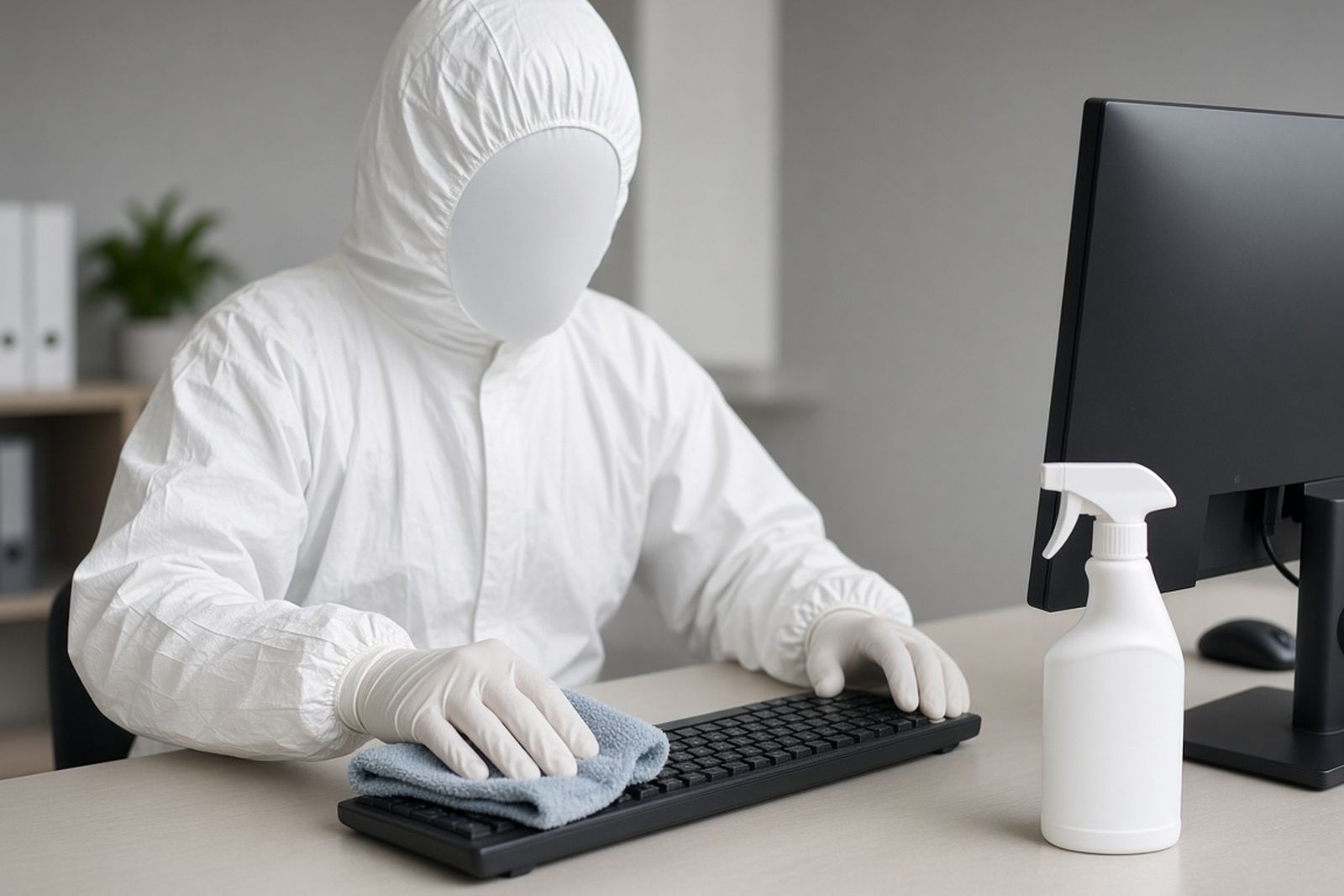
Disinfection works best on clean surfaces. A strong proposal lists cleaning equipment alongside application equipment: microfiber cloths, detergent solutions, mops with separate buckets or flat-mop systems, and scrub brushes for textured surfaces.
Wiping also allows the operator to feel and see whether a surface is clean, something no fogger can do. High-touch items such as door handles, light switches, railings, faucets, and shared equipment usually benefit from hands-on cleaning before any mist is applied.
If the proposal lists only a fogger and a disinfectant, ask who will handle cleaning first. The answer should be clear and written into the scope.
Color-coding is a small detail that says a lot. Many professional crews assign cloth and mop colors to specific zones, such as restrooms, kitchens, and general areas, so the same cloth never travels from a toilet to a break room counter. If a provider uses a color system, ask them to explain it; if they do not, ask how they prevent cross-contamination between areas.
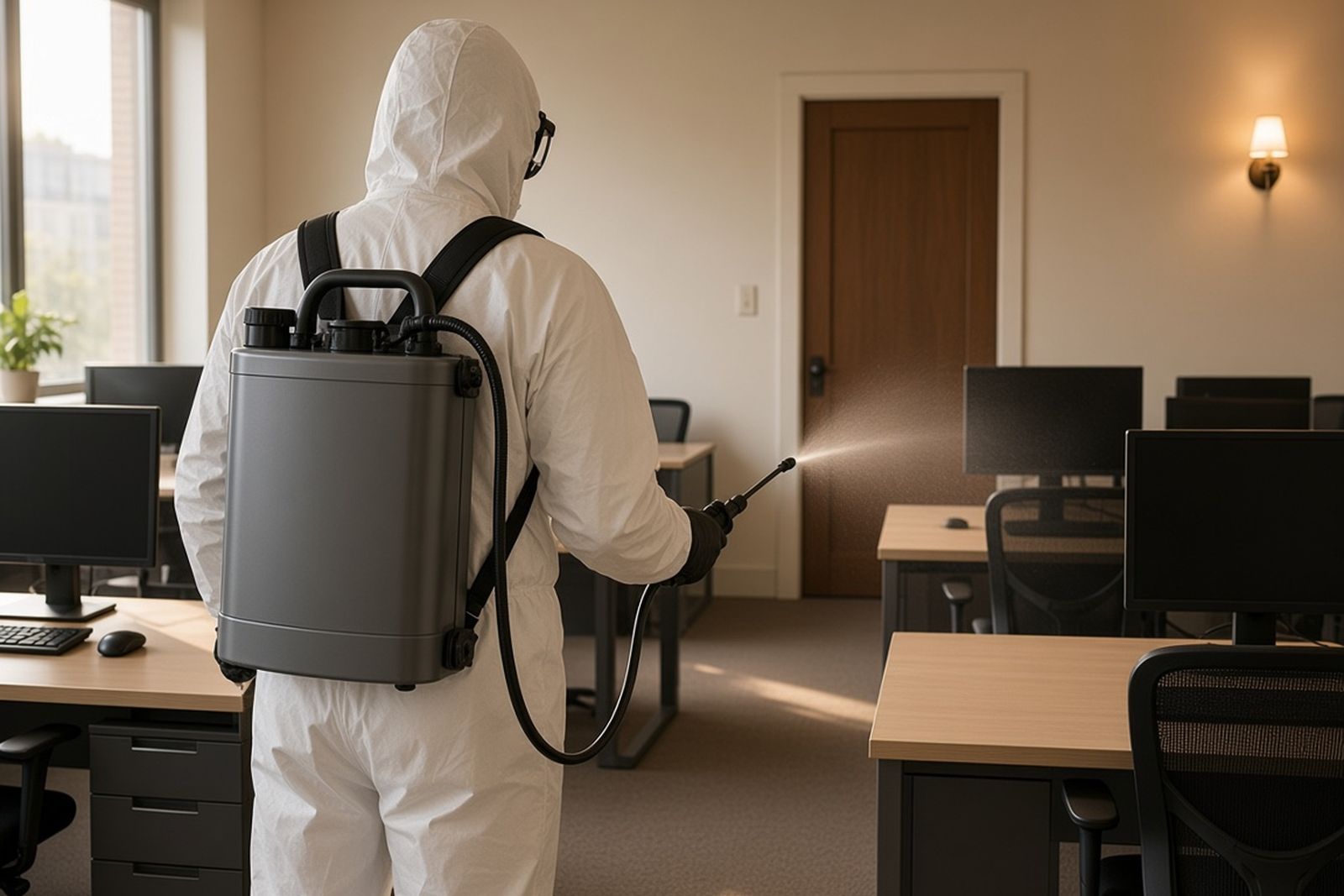
Applying disinfectant as a mist raises inhalation exposure for the operator. Crews should wear respiratory protection appropriate to the product, eye protection, and gloves, following the product's safety data sheet. Ask what respirators they use and whether workers are fitted and trained.
Safety equipment for the building matters too. Expect signage for doors, plastic covers for sensitive electronics or smoke detectors where appropriate, and a plan for shutting down and restarting air handling. The provider should know how to respond if someone enters during treatment.
Global guidance has been cautious about spraying in occupied spaces. A WHO expert review from 2021 notes that WHO's 2020 interim guidance strongly recommended against spraying or fogging disinfectants in occupied spaces. Any provider should be able to explain how they keep people out during treatment and when they can safely return.
How can a provider prove the equipment worked?
Verification separates a documented service from a visual show. ATP meters are a common tool. They measure adenosine triphosphate, a molecule found in living cells and organic residue, on a swabbed surface and give a reading in relative light units. Lower readings suggest a cleaner surface.
Benchmarks vary. A 2008 Journal of Hospital Infection study at a 1,300-bed UK teaching hospital proposed a stricter ATP pass/fail benchmark of 250 RLU for surfaces, revised down from the earlier general benchmark of 500 RLU. Your provider may use a different benchmark, but they should tell you what it is and why.
ATP readings do not identify specific germs, and they are most useful when taken before and after treatment on the same surfaces. Some providers also use fluorescent markers that show whether a surface was wiped. Ask what verification is included and how results will be shared.
Strong proposal vs weak proposal
Proposals that pair weekly electrostatic spraying with a UV-C robot are common in schools and offices. You can sort them quickly by what they explain rather than what they show.
A strong response names the disinfectant, shows you the label section permitting electrostatic application, explains the contact time, and describes how custodial staff will clean desks, handles, and cafeteria tables first. It specifies that rooms are empty during treatment, that air handling is paused, and that re-entry follows the label. For a UV-C device, it explains how shadowed areas under tables will be addressed and how the room is secured during cycles, and it includes ATP testing on a sample of surfaces on a stated schedule.
A weak response describes the equipment's features and offers photos, but skips the label, cleaning, re-entry, and verification. For schools, your state pesticide regulatory agency can also tell you whether specific rules on disinfectant application or applicator licensing apply.
You can also ask for a short trial on one wing or floor before committing to a building-wide contract. Watching the crew's process, reviewing their before and after readings, and hearing feedback from staff about odor or irritation will tell you more about the equipment than any brochure.
Sources
- Knobling et al. — Superiority of manual disinfection using pre-soaked wipes over automatic UV-C without prior cleaning
- WHO — A.18 Hypochlorous Acid for disinfection, antisepsis, and wound care (Expert Review for the 2021 EML Expert Committee)
- Journal of Hospital Infection — A modified ATP benchmark for evaluating the cleaning of some hospital environmental surfaces