Short answer
Sanitization and fogging have no single national certification. What matters is whether the company follows state pesticide applicator rules where they apply, trains staff on respiratory protection and chemical hazards, uses products labeled for the application method, and documents each job with the product, EPA registration number, dilution, contact time, areas treated, and re-entry time. Verify state requirements with your pesticide regulatory agency.
Why credentials matter for work that looks simple
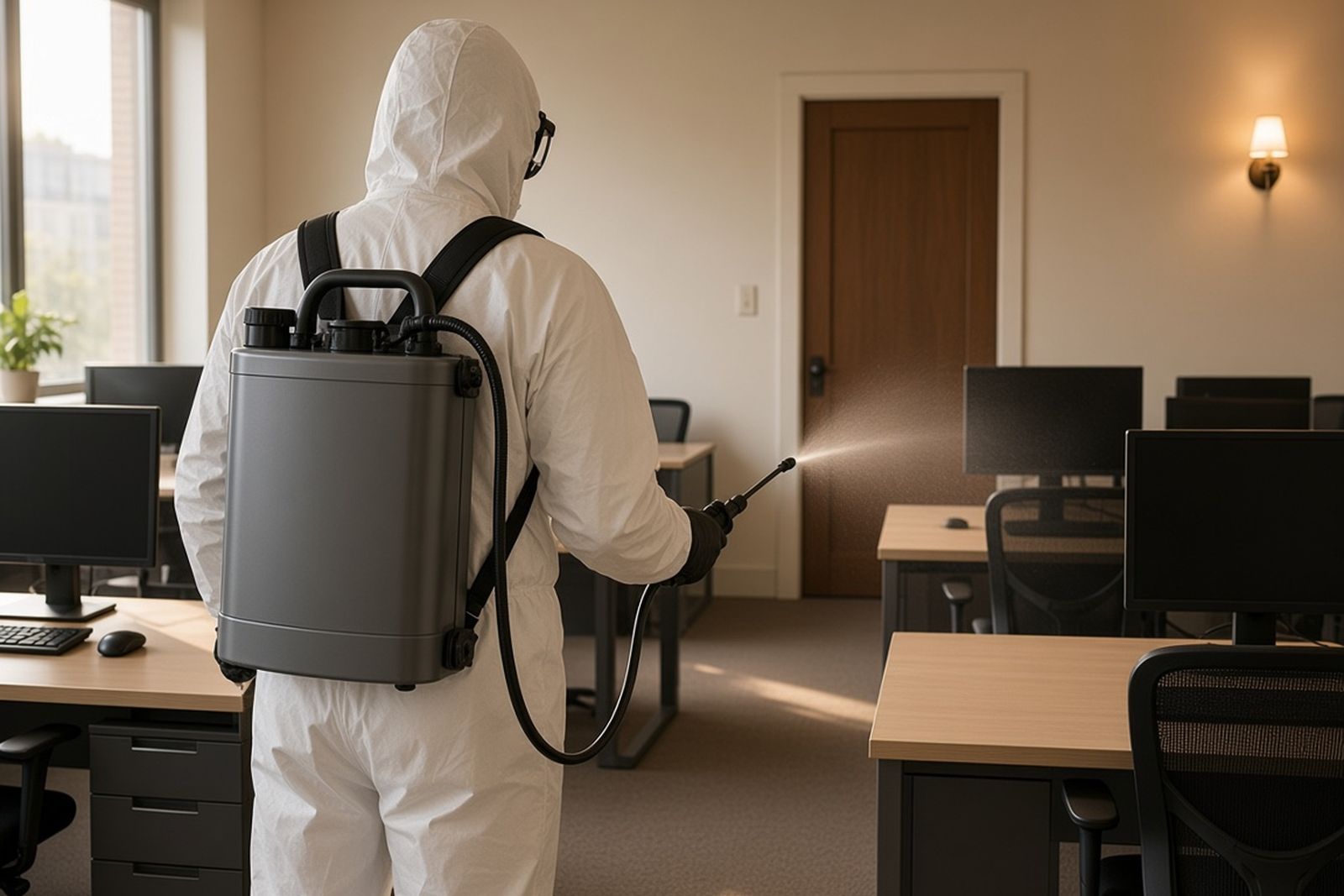
Fogging and electrostatic spraying can look like a matter of filling a tank and walking through a room. In practice, the work involves regulated chemicals, airborne droplets, occupied buildings, and label instructions that carry legal weight. The difference between a careful application and a careless one is mostly invisible to the client.
Credentials, training, and records are how you see that difference. They show whether the technician understands the product, protects the people in your building, and applies the disinfectant in a way that actually works.
There is no single national license for sanitization or fogging. Instead, several kinds of qualifications add up to a trustworthy provider. The sections below explain which ones matter most and what to ask for.
This matters most in buildings where people are vulnerable: schools, daycares, senior living communities, clinics, and homes with infants or residents who have asthma. In those settings, a careless application does not just waste money. It can leave people breathing residue or returning to a room before it is ready.
Do fogging companies need a pesticide license?
Disinfectants and sanitizers that claim to kill germs are regulated as antimicrobial pesticides at the federal level. States then decide how to regulate the people who apply them commercially. Some states require a pesticide applicator license or business registration for certain kinds of antimicrobial application, while others exempt some or all disinfection work.
Because the rules vary so widely, the best approach is to ask the company what its state requires and how it complies. A knowledgeable provider will know whether its work falls under a licensing category, and if so, will give you the license number so you can check it with the state agency.
Rules vary by state and county; verify with the local authority, usually your state department of agriculture or pesticide regulatory office, before assuming a license is or is not needed for the services being offered.
Even where no license is required, the product label still governs how the disinfectant may be used. Licensing is about who may apply a product; the label is about how. A company can be fully licensed and still misuse a product, so ask about both.
Technician training
Beyond any license, technicians need practical training on the chemicals and equipment they use. Hazard communication training teaches them to read labels and safety data sheets, understand health hazards, and avoid mixing incompatible products.
Respiratory protection is essential for anyone fogging or spraying in enclosed spaces. When an employer requires respirators, it generally needs a respiratory protection program with medical evaluation, fit testing, and training. A technician wearing a respirator without that program may not be protected as well as it appears.
Training also covers the equipment itself: how to calibrate a sprayer, choose the right nozzle, maintain proper distance from surfaces, and clean the machine afterward so residue does not build up or react with the next product.
Ask how often training is refreshed and how new hires are supervised. A technician on the first week of the job should be working alongside someone experienced, not sent alone to a daycare or clinic. Companies with real programs can describe their onboarding in a sentence or two.
- Hazard communication and safety data sheet training.
- Respiratory protection with fit testing and medical clearance.
- Device operation, calibration, and maintenance.
- Reading and following product labels, including application method and contact time.
- Protecting occupants, food areas, and sensitive equipment.
- Spill response for concentrated products.
Respiratory health deserves special attention
Disinfectants put into the air can affect the lungs of the people applying them and anyone who re-enters too early. NIOSH stated in 2021 guidance that clinically important asthma from airborne disinfectants can occur at exposure concentrations below the occupational limits regulated by OSHA or recommended by NIOSH.
Workers do not automatically know this. Training on respiratory hazards cannot be assumed, even for experienced cleaning staff, so it is worth asking about directly.
When you hire a company, ask how it protects its technicians and your occupants from respiratory exposure. Good answers include respirators matched to the product, keeping people out during application, following the label's re-entry time, and ventilating before occupants return.
Job documentation and verification testing
A written record is one of the clearest signs of a professional provider. It shows exactly what was applied, where, and how, and it gives you something to share with staff, parents, tenants, or inspectors who ask.
Ask to see a sample report before hiring. If it lists only the date and the words sanitized building, it will not help you much later.
Documentation also protects the provider. If an occupant later reports a headache or rash, a clear record of the product, dilution, and re-entry time lets everyone check quickly whether the label was followed. Companies that keep good records tend to welcome that kind of scrutiny, because it usually confirms the work was done correctly.
Some providers offer testing to check how clean surfaces are before and after treatment. A common tool is ATP testing, which measures organic residue on a surface using a swab and a handheld reader. It does not identify specific germs, but it gives a quick indication of cleanliness.
Benchmarks vary, and different devices and settings use different scales, so ask any provider which benchmark it uses and why.
Verification testing is not required for every job, and it does not prove that a space is free of disease. But a provider that offers it and explains its limits is showing a commitment to measurable results rather than just the appearance of mist.
- Product name and EPA registration number.
- Dilution or concentration used.
- Application method and device, such as electrostatic sprayer or fogger.
- Areas and rooms treated, with any exclusions noted.
- Contact time followed and re-entry time observed.
- Pre-cleaning performed, and by whom.
- Technician name and date and time of service.
- Any verification testing performed and results.
Business credentials to confirm
Ask for current certificates of general liability and workers' compensation insurance. Chemical application in occupied buildings carries risks, including damage to finishes or electronics and potential health complaints, and you want to know the company is covered.
Confirm the business is registered in your state. If the company claims affiliation with a trade association or training program, ask for the name so you can verify it independently.
For recurring service contracts, read how the agreement describes the scope, frequency, and products. A contract that allows the provider to switch products without notice makes it harder for you to keep safety data sheets current and to respond to occupant concerns.
Ask, too, about how the company stores and transports concentrated chemicals. Products kept in labeled original containers, secured in vehicles, and mixed on site according to label directions are signs of an organized operation.
A three-question vendor check
You do not need a long questionnaire to compare vendors. Three written questions usually separate them: what product will you use, and is it labeled for your application method? What training and licensing do your technicians have? What will we receive afterward?
A strong reply attaches the product label, safety data sheet, and EPA registration number. It states whether the company's state requires a pesticide license for this service, and if not, still describes respirator fit testing and hazard communication training for its technicians. It includes a sample job report.
A weak reply says the company uses a hospital-grade solution and is fully certified, with no further detail. Once you have chosen, post the product information for employees with sensitivities and keep the job report on file.
What to ask before you sign
Keep your questions short and specific. Ask what licenses apply in your state and whether the company holds them. Ask what training technicians complete, especially for respirators and chemical hazards. Ask for the product label, safety data sheet, and EPA registration number. Ask for proof of insurance and a sample job report.
Then ask how the company decides whether fogging is the right method at all. A provider with real expertise will sometimes recommend targeted cleaning and wiping instead, because that is what the situation calls for.
The companies worth hiring welcome these questions. They know their credentials and paperwork are what separate careful work from a quick spray, and they are glad to show you the difference.