Short answer
Match each device in the quote to a clear purpose. Check that the disinfectant label allows the way it will be applied. Check that the droplet size suits your surfaces and that cleaning tools are included. Make sure breathing protection and re-entry plans cover your people and the crew. Ask how the company will prove results, such as with a quick swab test, and not just by how the mist looks.
The plan matters more than the machine
Fogging quotes often lead with equipment: a new electrostatic sprayer, a hospital-grade fogger, a UV robot. Photos of mist drifting across a gym or a lamp glowing in an empty classroom can win you over. But a machine is only as good as the product it applies, the surfaces it reaches, and the steps before and after.
When you judge equipment, try to tie each device to a job it does. What surfaces will it treat? What product will it apply? How will anyone know it worked? A company that answers those questions clearly is offering you a plan. One that talks mostly about the machine's features is giving you a product demo.
Below are the main kinds of equipment you may see in a quote. With each come the questions that help you decide if it fits your building.
Foggers vs electrostatic sprayers
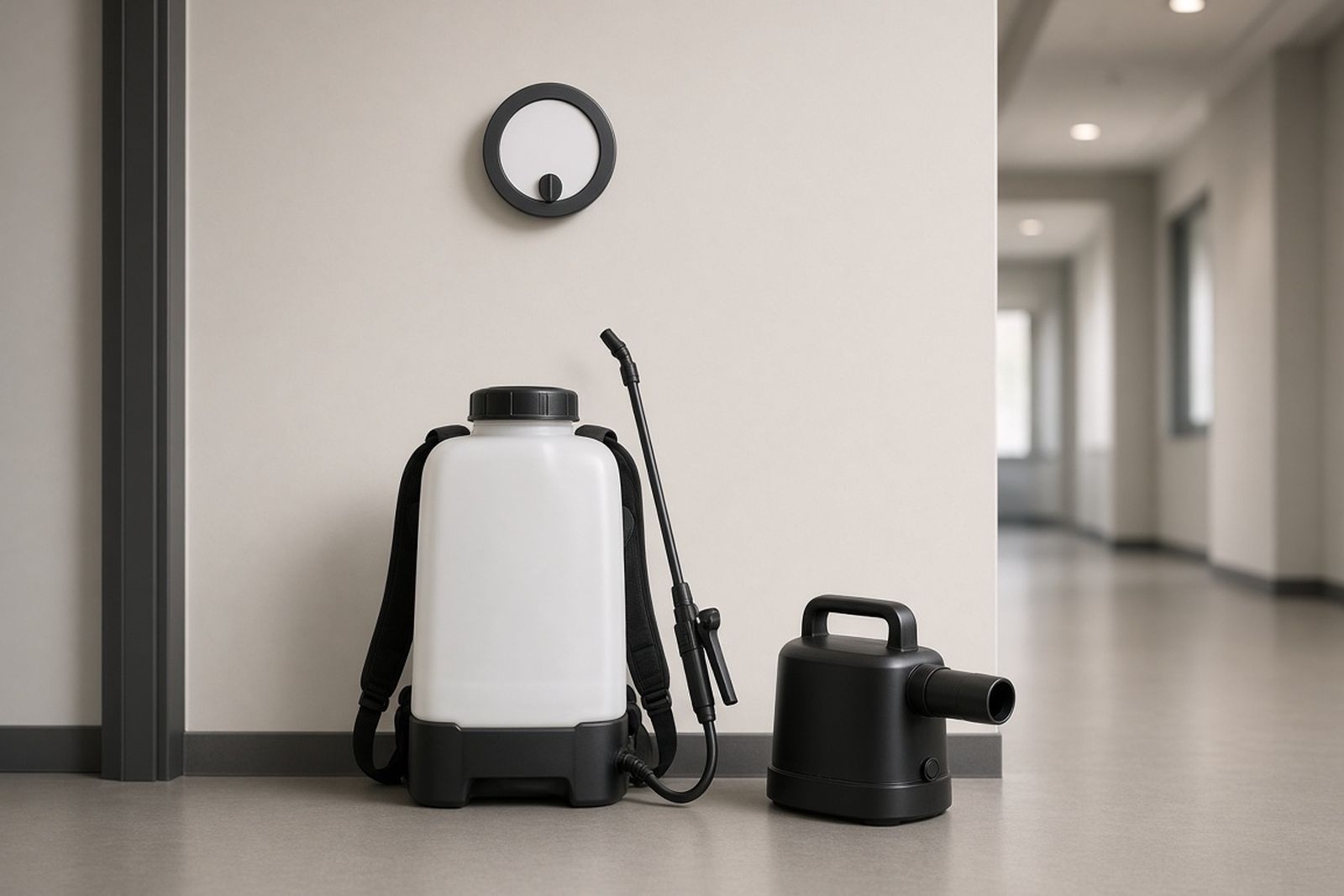
Ultra-low-volume foggers, sometimes called ULV or cold foggers, break liquid into fine droplets and push them into the air. There they drift and settle. Thermal foggers use heat to make an even finer fog. Electrostatic sprayers make somewhat larger droplets and give them an electric charge, so they are drawn toward surfaces.
Each has trade-offs. Finer droplets travel farther. But they may dry up or stay in the air longer. That raises breathing concerns and leaves less liquid on your surfaces. Larger droplets land more surely and keep surfaces wetter. But they do not drift as far, and the operator has to aim with care. The electric charge helps with edges and some hidden sides. It does not promise full coverage.
Ask what droplet size the equipment makes and why that size suits your space. Ask how the operator makes sure the often-touched surfaces are covered. Also ask if the product label clearly allows use with that kind of device.
Upkeep matters as well. Nozzles clog, batteries weaken, and worn parts change the droplets that come out. A sprayer that is not cleaned and checked often may put out less product than the operator thinks. Ask how often the equipment is serviced and if the company checks its output before each job.
- Cold or ULV foggers: fine droplets, wide drift, less wetness on surfaces.
- Thermal foggers: very fine fog, rarely suited to business spaces with people in them.
- Electrostatic sprayers: larger charged droplets that land where they are aimed.
- Trigger or pump sprayers: simple, easy to control, often paired with wiping.
Vapor systems and whole-room units
Hydrogen peroxide vapor systems and peroxide mist systems are used mainly in healthcare and labs. The room is sealed, the machine runs a cycle, and then everyone waits for the vapor to break down before going back in. With trained operators in the right setting, they can reach surfaces that are hard to clean by hand.
These systems are complex. Rooms must be emptied of people and sealed with care. Sensors may be needed to track the level in the air. Cycles take time. They are rarely the right tool for a normal office, gym, or store.
If a company offers a whole-room system for your building, ask what setting it was made for. Ask how the room will be sealed, how the level in the air will be tracked, and what must be true before anyone goes back in.
No-touch options: UV-C lamps and ozone generators
UV-C lamps and robots use a kind of ultraviolet light. They can inactivate germs on surfaces the light hits directly. They leave no chemical residue, which appeals to many building managers. But light does not bend around objects. Shadows, distance, and dust all weaken its effect.
Research has compared UV-C with wiping by hand. A 2023 study by Knobling and colleagues found that manual wiping with pre-soaked wipes met the study's disinfection-success criterion on 98.1% of surfaces, versus 75.5% for UV-C used without prior cleaning. That does not make UV-C useless. It suggests UV-C works best as an addition to cleaning, not a swap for it.
UV-C can also harm skin and eyes, so rooms must be empty during treatment. Ask how the device is controlled and what safety shutoffs it has. Ask how the company deals with surfaces that sit in shadow.
Ozone generators are sometimes offered as part of a package, often for odor. Ozone is a reactive gas that can irritate your lungs and harm some materials. It should never be used in spaces with people in them. Rooms need a full airing before anyone returns.
Be careful with claims that ozone disinfects a building. Public health agencies have warned again and again about this. Ozone at levels safe for people does not work well to remove germs and mold from indoor air. If a quote includes ozone, ask what it is meant to do. Ask how your people and pets will be protected and how long the space will be off limits.
In most business settings, ozone is better seen as a special odor tool used under strict conditions. It is not a way to disinfect.
Cleaning tools and safety gear belong on the list
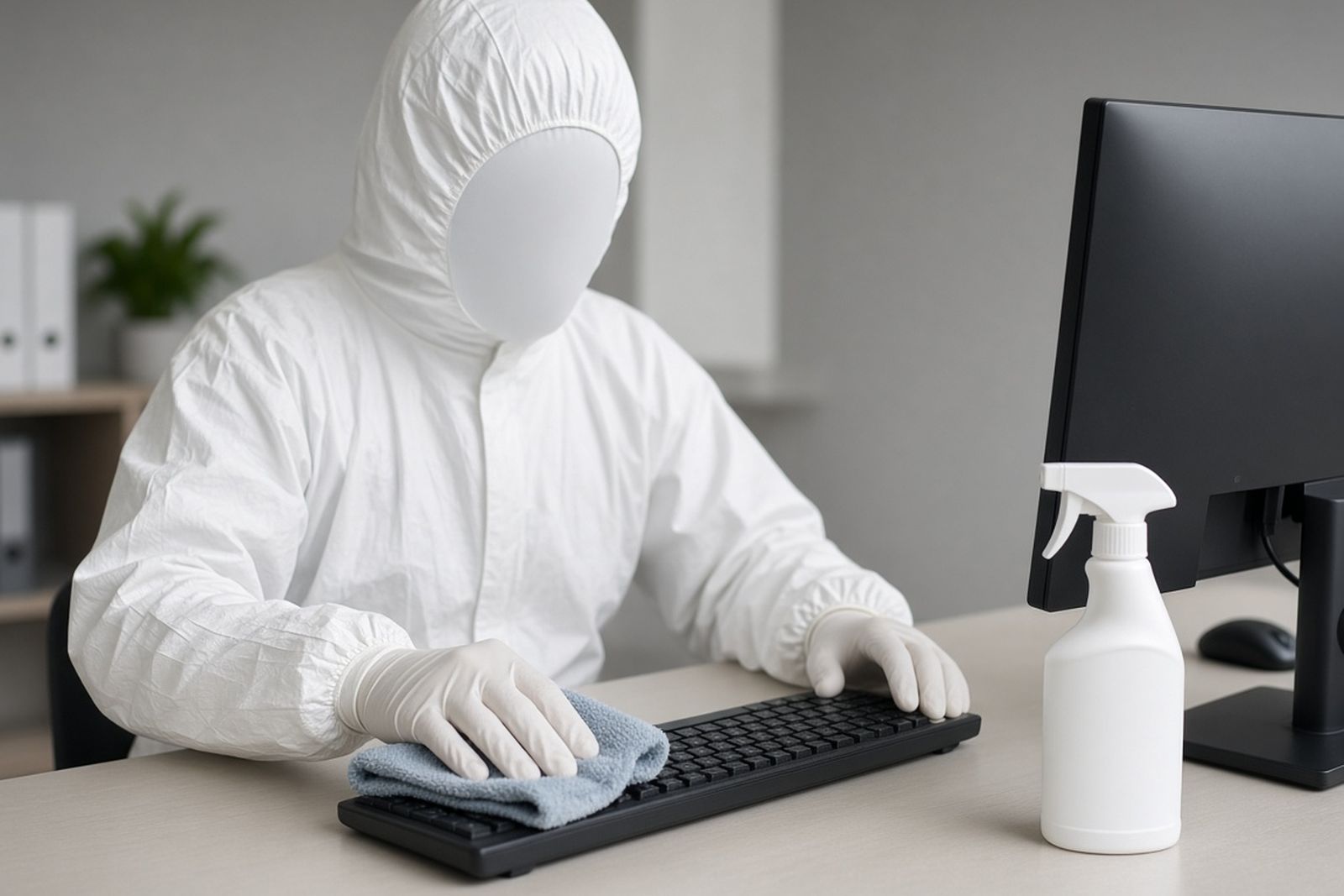
Disinfecting works best on clean surfaces. A strong quote lists cleaning tools next to the spraying equipment. Look for microfiber cloths, detergent solutions, and scrub brushes for textured surfaces. Look for mops with separate buckets or flat-mop systems.
Wiping also lets the worker feel and see if a surface is clean. No fogger can do that. Often-touched items such as door handles, light switches, railings, faucets, and shared equipment usually gain from cleaning by hand before any mist goes on.
If the quote lists only a fogger and a disinfectant, ask who will do the cleaning first. The answer should be clear and written into your work plan.
Color-coding is a small detail that says a lot. Many professional crews give cloth and mop colors to certain zones, such as restrooms, kitchens, and general areas. That way the same cloth never travels from a toilet to a break room counter. If a company uses a color system, ask them to explain it. If not, ask how they keep germs from being carried between areas.
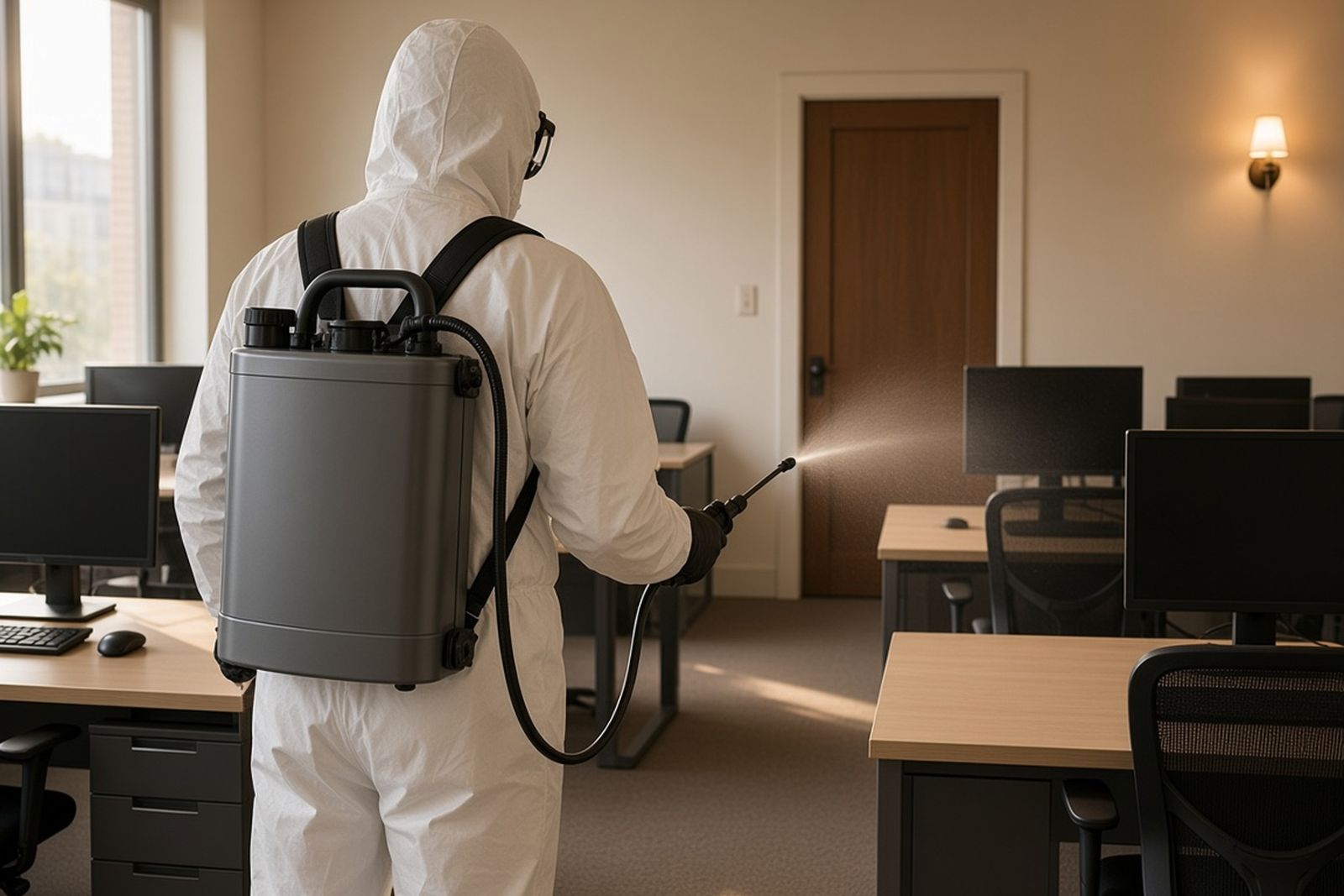
Applying disinfectant as a mist means the operator breathes in more of it. A careful crew wears breathing protection that suits the product, plus eye protection and gloves. They follow the product's safety data sheet, the maker's fact sheet on hazards. Ask what breathing masks they use and if workers are fitted and trained.
Safety equipment for your building matters, too. Expect signs for doors and a plan to shut down and restart the air system. Expect plastic covers for delicate electronics or smoke detectors where that is called for. The company should know what to do if someone walks in during treatment.
World health guidance has been wary of spraying in spaces with people in them. A WHO expert review from 2021 notes that WHO's 2020 interim guidance strongly recommended against spraying or fogging disinfectants in occupied spaces. Any company should be able to explain how they keep people out during treatment and when your people can safely return.
How can a company prove the equipment worked?
Proof of results separates a recorded service from a show. A common tool is a handheld swab meter. A surface is swabbed, and the meter measures adenosine triphosphate, a molecule found in living cells and organic residue. It gives a reading in relative light units, or RLU. Lower readings suggest a cleaner surface.
Pass marks vary. A 2008 Journal of Hospital Infection study at a 1,300-bed UK teaching hospital proposed a stricter pass/fail benchmark of 250 RLU for surfaces, down from the earlier general benchmark of 500 RLU. Your company may use a different pass mark. But they should tell you what it is and why.
These swab readings do not name the germs present. They are most useful when taken before and after treatment on the same surfaces. Some companies also use glowing marker gel that shows if a surface was wiped. Ask what proof is included and how you will get the results.
Strong proposal vs weak proposal
Quotes that pair weekly electrostatic spraying with a UV-C robot are common in schools and offices. You can sort them quickly by what they explain, not by what they show.
A strong one names the disinfectant and shows you the part of the label that allows electrostatic spraying. It explains the wet time. It describes how your cleaning staff will clean desks, handles, and cafeteria tables first. It says rooms are empty during treatment, the air system is paused, and re-entry follows the label. For a UV-C device, it explains how shadowed areas under tables will be handled and how the room is secured during cycles. It also includes swab testing on a sample of surfaces on a stated schedule.
A weak one describes the equipment's features and offers photos. It skips the label, the cleaning, the re-entry plan, and the proof of results. If you run a school, your state pesticide regulatory agency can also tell you if special rules apply. These may cover how disinfectant is applied or who needs a license to apply it.
You can also ask for a short trial on one wing or floor before you commit to a contract for the whole building. Watch how the crew works. Review their before and after readings. Hear from your staff about any smell or irritation. That will tell you more about the equipment than any brochure.
Sources
- Knobling et al. — Superiority of manual disinfection using pre-soaked wipes over automatic UV-C without prior cleaning
- WHO — A.18 Hypochlorous Acid for disinfection, antisepsis, and wound care (Expert Review for the 2021 EML Expert Committee)
- Journal of Hospital Infection — A modified ATP benchmark for evaluating the cleaning of some hospital environmental surfaces