Short answer
Fogging and electrostatic spraying work only when disinfectant droplets land on a surface, stay wet for the full label contact time, and meet a surface already cleaned of soil. Droplet size controls where the mist settles, electric charge helps droplets reach some hidden sides, and the product label decides whether the method is allowed at all. Mist in the air disinfects nothing.
What happens when a room is fogged
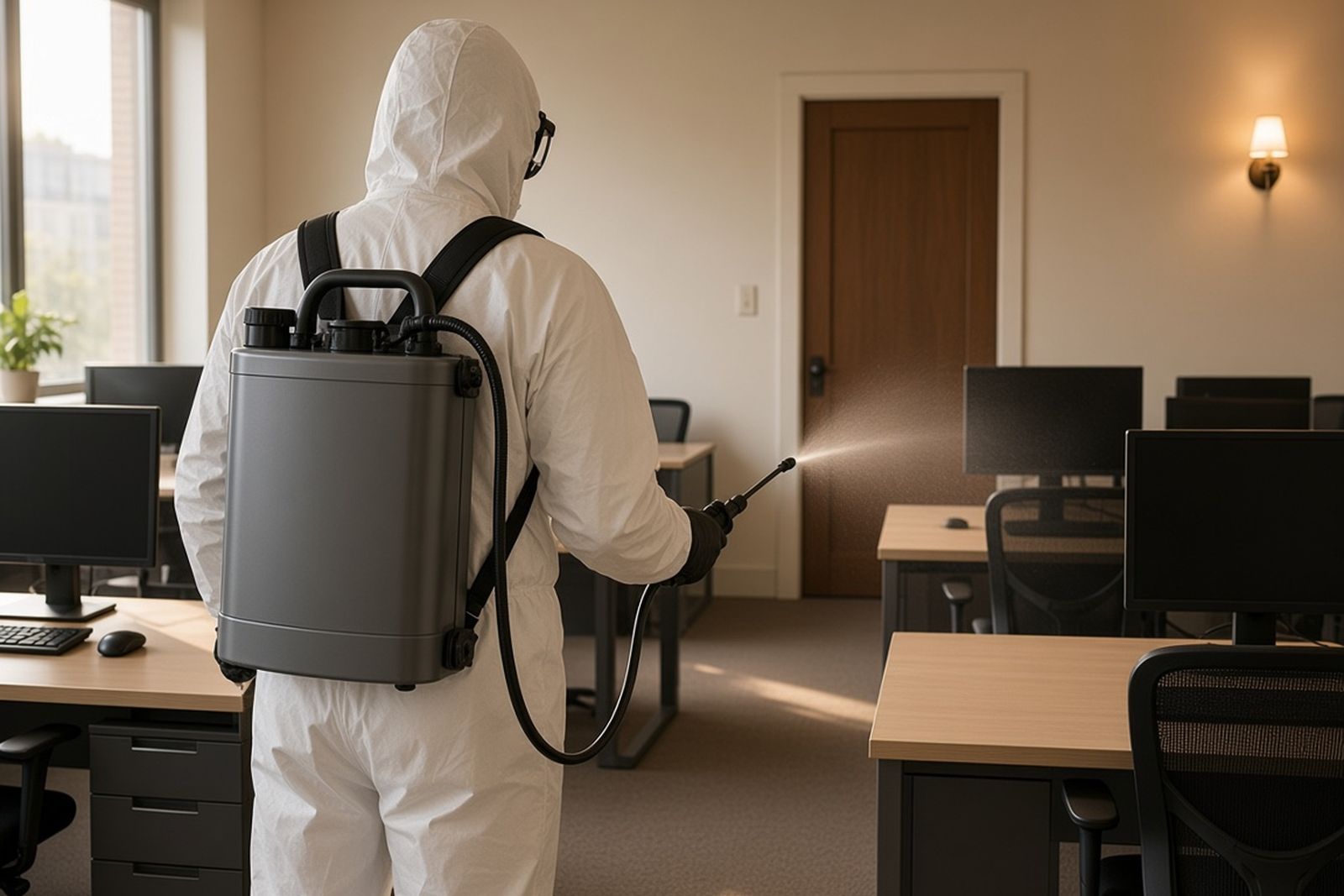
A fogger or sprayer breaks a liquid disinfectant into small droplets and pushes them into the air. From there, the droplets drift, collide, evaporate, and eventually settle onto whatever is below them. The disinfecting only happens after landing, when the product sits on a surface long enough to act on microorganisms there.
That simple chain explains most of what makes fogging succeed or fail. If droplets evaporate before they land, nothing happens. If they land too thinly to keep the surface wet, the product may not finish its work. If they land on a layer of grime, the active ingredient may be used up before it reaches the germs beneath.
Understanding the chain helps you ask better questions. Instead of asking how impressive the mist looks, you can ask how much product lands on the surfaces that matter, and for how long it stays wet.
Droplet size and electric charge
Droplet size controls how long a droplet stays in the air and where it ends up. Very fine droplets hang in the air, travel farther, and can evaporate before landing. Larger droplets fall faster, land closer to the nozzle, and leave more liquid behind on the surfaces they hit.
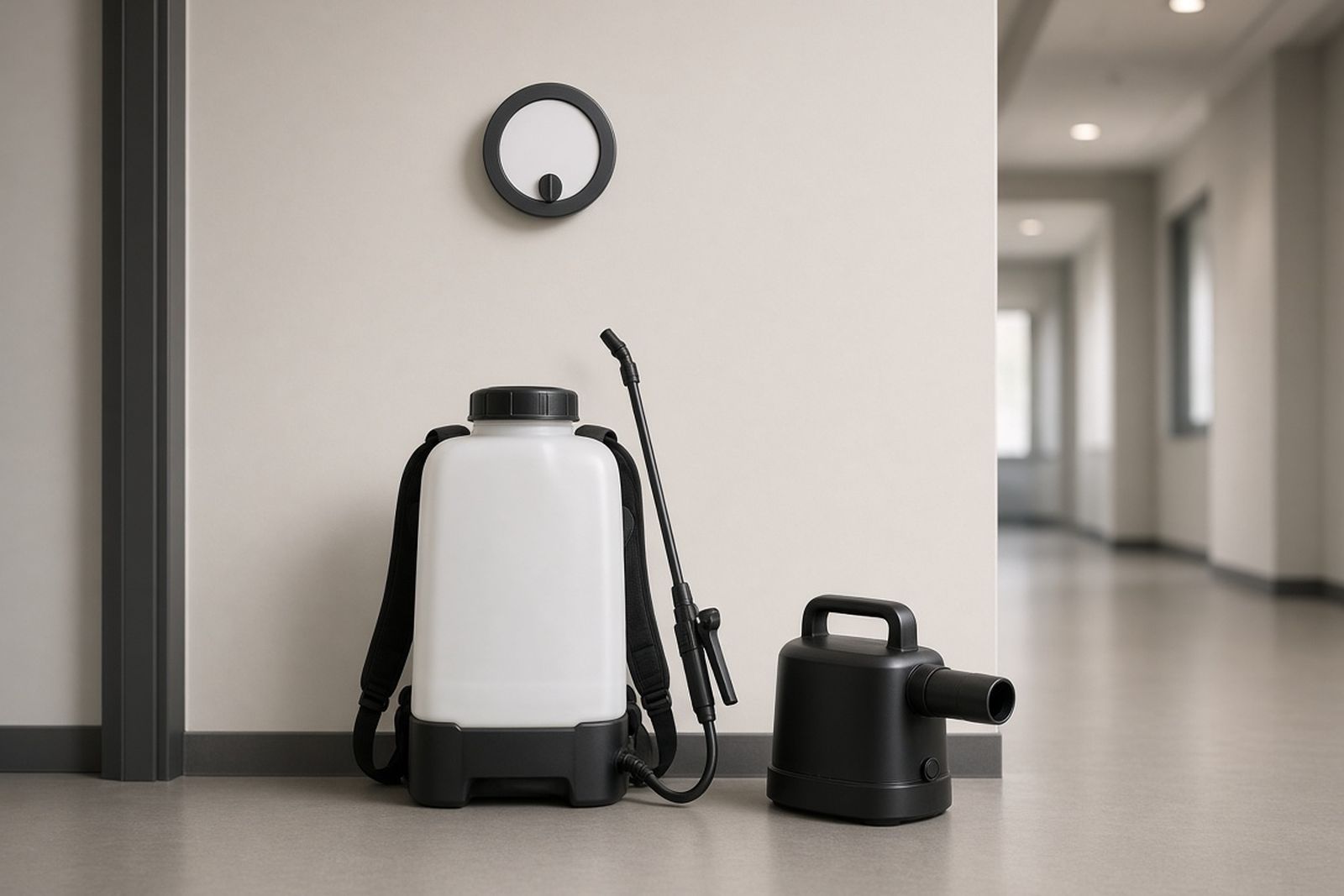
Different equipment produces different size ranges. Ultra-low-volume foggers produce fine droplets, thermal foggers produce very fine ones, and electrostatic sprayers usually produce somewhat larger droplets. Each design trades reach against wetness, and none is automatically better for every job.
Real-world testing has tempered some marketing claims. In EPA testing published in PLOS ONE in 2021, researchers evaluated six electrostatic sprayers, two foggers, and a garden sprayer, and found that most devices produced droplets of 40 microns or larger and showed minimal wrap-around deposition on an 8-inch cylinder. In other words, the back sides of objects did not get covered as much as the term wrap-around might suggest.
Room conditions shift the picture further. Low humidity speeds evaporation, so fine droplets may shrink and drift instead of landing. High ceilings give droplets more time in the air before they settle. Open doors, ceiling fans, and running air handlers carry mist away from the target surfaces and sometimes into areas nobody meant to treat.
Electrostatic sprayers give droplets an electric charge as they leave the nozzle. Charged droplets repel each other, which can help them spread out, and they are drawn toward surfaces, especially conductive ones. In principle, that helps droplets reach edges and some shadowed areas a plain spray would miss.
In practice, the benefit depends on the surface material, the distance from the nozzle, humidity, and the operator's technique. A technician still needs to move around the room, aim at each surface, and approach from more than one side. Charge improves the odds; it does not replace coverage planning.
The practical question for you is whether the provider treats the sprayer as a shortcut or as one tool within a careful process. A crew that walks every angle and checks surfaces afterward will get more from the same machine.
Contact time: the key number
Every registered disinfectant lists a contact time on its label. That is the length of time the surface must stay visibly wet for the product to achieve the kill claims printed there. Contact times differ by product and by the organism listed.
Fine mists create a particular challenge. A thin film dries quickly, especially in warm, dry rooms or where air is moving. If a surface is dry after a short time and the label requires a longer contact period, the disinfection claim no longer applies to that application.
Good providers plan around this. They choose products with contact times that match the method, adjust the amount applied, turn off air handlers during application when appropriate, and sometimes reapply to keep surfaces wet. Ask any provider how they confirm that surfaces stay wet for the full label time.
- Check that the product label lists the organisms you care about.
- Note the contact time for those organisms.
- Ask how the crew keeps surfaces wet for that full period.
- Confirm what happens to air handling during and after application.
Why surfaces must be cleaned before they are fogged
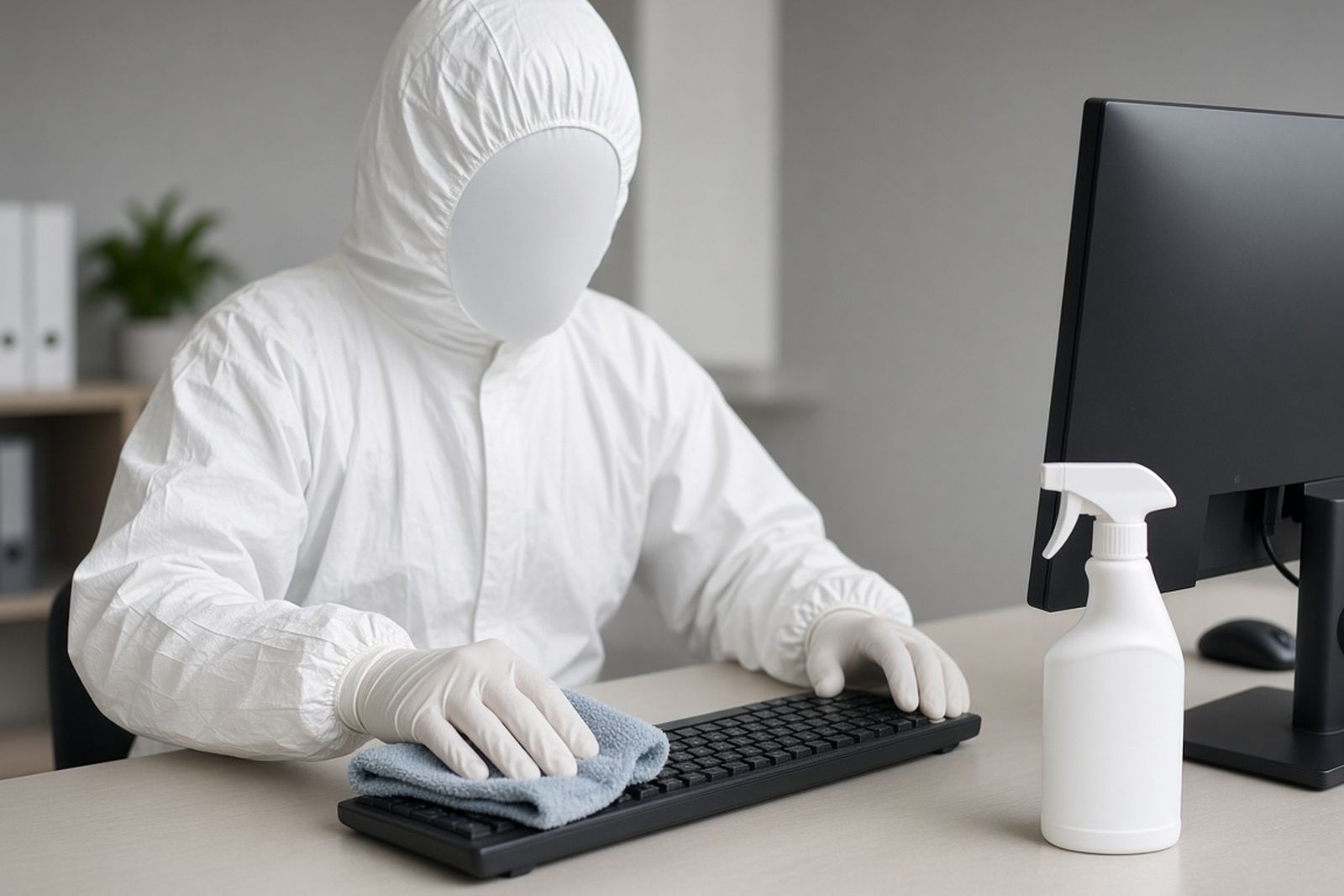
Dirt, grease, body oils, and dried spills all interfere with disinfectants. They can physically shield microorganisms, and they can react with the active ingredient and weaken it. A disinfectant that works well on a clean test surface may perform far worse on a sticky counter.
That is why the sequence matters: clean first, then disinfect. Cleaning with detergent and friction removes the bulk of soil and many microorganisms along with it. The disinfectant then works on a surface it can actually reach.
A proposal that skips the cleaning step, or treats fogging as a replacement for wiping, is asking the chemistry to do something it was not designed to do. High-touch surfaces such as door handles, light switches, railings, and shared equipment usually still need hands-on cleaning.
Biofilms are a less visible version of the same problem. On surfaces that are rarely scrubbed, such as drain rims, shower grout, and the undersides of shared equipment, microorganisms can build a protective, sticky layer. A light mist settling on top of that layer is unlikely to penetrate it. Physical scrubbing breaks the film so the disinfectant has something to work on.
The label decides what is allowed
Disinfectant labels are not suggestions. They set out how a product may be used, including dilution, contact time, surfaces, and application method. The EPA's current guidance says it does not recommend applying disinfectants by fogging, fumigation, wide-area or electrostatic spraying, or drones unless the product label specifically includes directions for that method.
That matters for safety and effectiveness. A product tested as a wipe or trigger spray has not necessarily been tested as a fine mist, where inhalation exposure and coverage behave differently. Using it that way may put occupants at risk and may not deliver the stated kill claims.
Some states also have pesticide applicator licensing rules that can apply to certain disinfection work; your state pesticide regulatory agency can confirm. A trustworthy provider will show you the label and point to the section that permits the method they plan to use.
Ozone, UV, and other no-contact methods
Some services pair fogging with ozone generators or ultraviolet lamps. Each has its own science and its own limits. Ozone is a reactive gas that can irritate the lungs, and it does not deliver a disinfectant to surfaces the way a labeled product does.
Ultraviolet light can inactivate microorganisms on surfaces it reaches directly, but shadows, distance, and dust reduce its effect sharply. A lamp in the middle of a room does little for the underside of a desk or the inside of a cabinet.
These tools can have a place in a well-designed program, usually in controlled settings with trained operators and clear re-entry rules. They are not substitutes for cleaning, and claims that they sanitize an entire building in minutes deserve careful questions.
From the science to a service plan
Put the chain together and a science-based plan for any shared space, such as a daycare after a stomach bug, follows the same order. It starts with the product label: does it list the relevant virus, and does it allow the proposed application method?
Next comes cleaning. Toys, tables, cribs, changing stations, and bathroom fixtures are washed first, because soil from hands and diapers would otherwise interfere with the chemistry.
Only then does a targeted application make sense, with air handling turned off during treatment, rooms closed for the time the label specifies, and surfaces kept wet for the full contact time. Food-contact surfaces and toys that go in mouths may need a rinse afterward if the label requires it. Written re-entry times and a list of what was treated close the job.
Whole-building overnight fogging offered as a single fix skips most of that chain. The fog belongs at the end of the sequence, not in place of it.
Focus on outcomes rather than equipment. Ask how the provider cleans before disinfecting, how they know product lands on the surfaces you care about, how they maintain contact time, and what the label says about their method. Ask about re-entry times, ventilation, and whether anyone in your building has asthma or chemical sensitivity that should change the plan.
A provider who can answer those questions clearly is working from the science. One who leans on how thick the fog looks, or who cannot show you a label, is working from appearances. Your building, and the people in it, deserve the first kind.
It is also worth remembering the people who will breathe the space afterward. Residue left on surfaces, lingering airborne droplets, and fragrance additives can bother staff, children, and anyone with respiratory conditions. A science-based provider treats ventilation and re-entry as part of the service, not an afterthought, and will explain how long to wait before people return.