Short answer
To evaluate fogging and disinfection technology, check whether the product label permits the device's application method, ask what evidence supports coverage claims, confirm how contact time and re-entry are handled, and compare the whole process, including cleaning and downtime, with simpler wiping. Newer equipment can help in specific settings, but no device replaces cleaning first or following the label.
Why brochures are a poor guide
Disinfection technology is marketed with striking images: blue mist wrapping around a chair, a robot bathing a hospital room in violet light, a drone gliding over stadium seats. Those images are designed to suggest total coverage. What they rarely show is what actually landed on the surfaces, whether it stayed wet long enough, and whether the room was clean to begin with.
The rapid growth of the field after 2020 made the problem harder. New devices appeared quickly, older technologies were repackaged, and many buyers had no baseline for comparison. Some equipment has solid evidence behind it in particular settings. Some does not.
You do not need an engineering background to evaluate these tools. You need a short set of questions and a willingness to ask for evidence rather than adjectives.
The first question for any device
Does the product label allow this application method? A disinfectant should be fogged, sprayed electrostatically, or dispersed by drone only where its own label gives directions for that method.
That puts the label ahead of the machine. An advanced electrostatic sprayer loaded with a product that has no electrostatic directions is not a label-compliant disinfection method, however good the hardware is. The disinfectant's kill claims were established under specific conditions, and changing the application method can change whether those claims hold.
So before you evaluate the equipment, ask which product will go in it, and read the label. If the answer is vague, the rest of the evaluation does not matter much.
Electrostatic sprayers vs ULV and thermal foggers
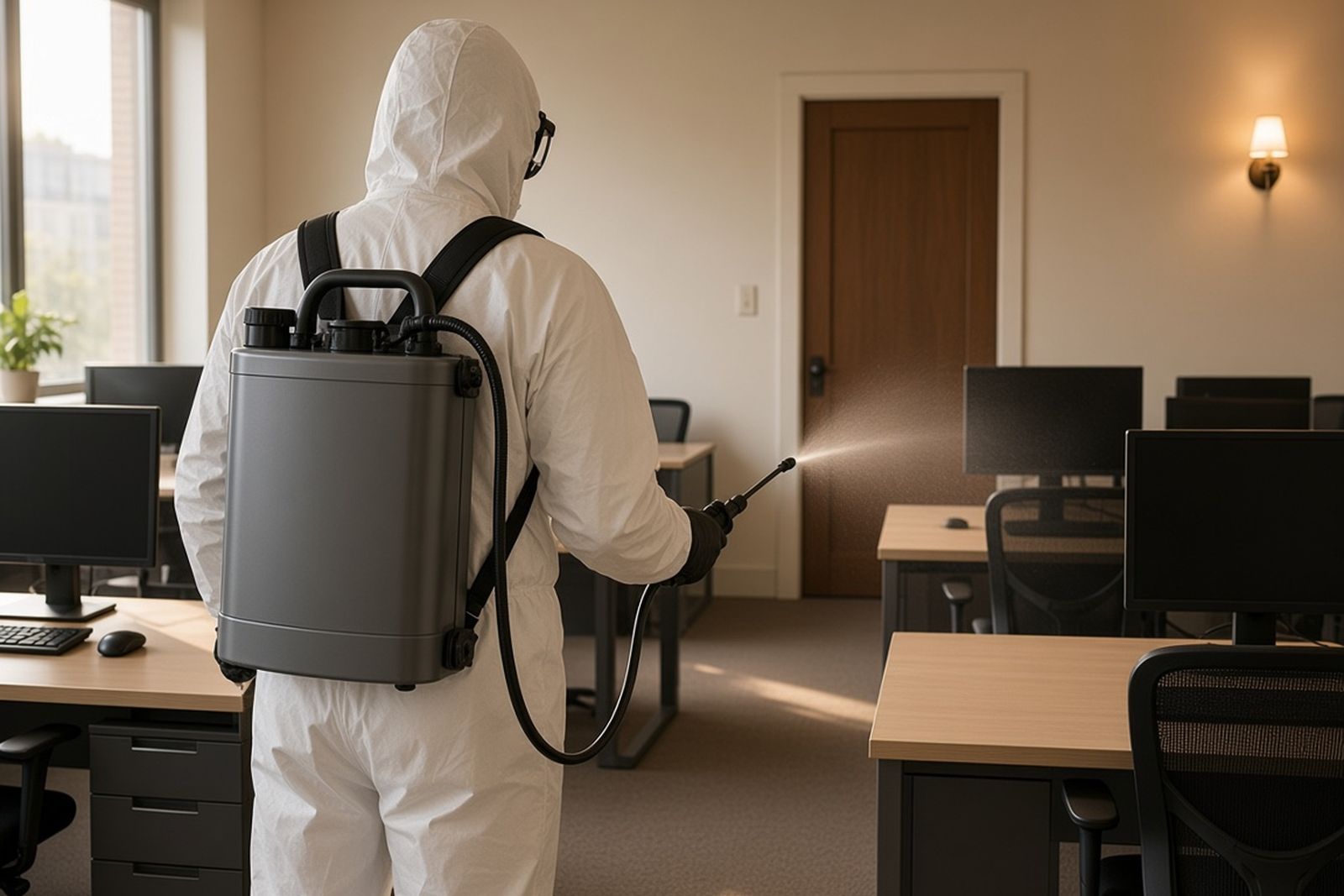
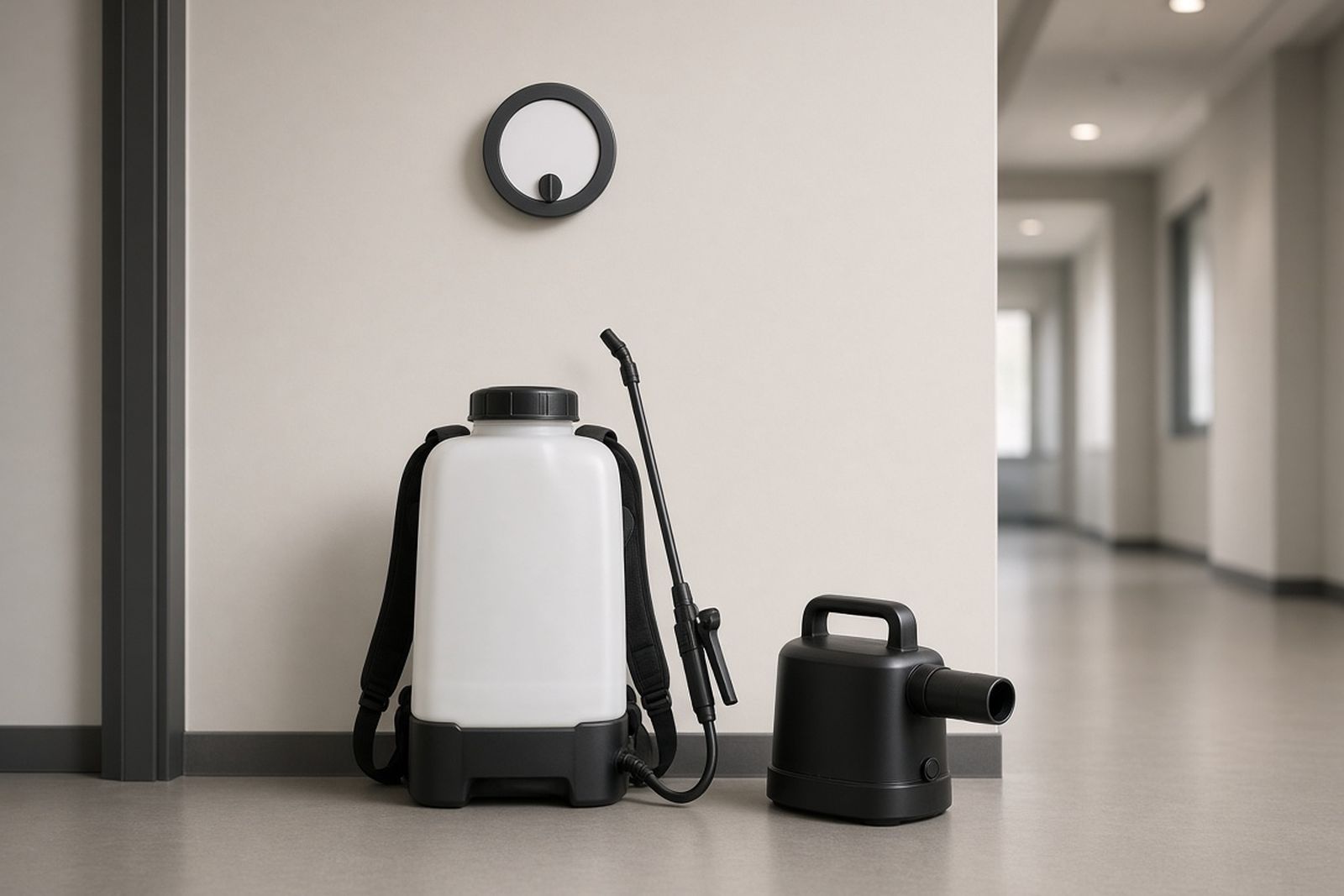
These devices all turn liquid into droplets, but at different sizes and with different delivery. Ultra-low-volume foggers produce fine droplets that hang in the air and spread widely. Thermal foggers use heat to create even finer particles. Electrostatic sprayers produce somewhat larger droplets and give them an electric charge so they are attracted to surfaces.
Coverage claims deserve scrutiny. In EPA testing published in PLOS ONE in 2021, researchers evaluated six electrostatic sprayers, two foggers, and a garden sprayer; most devices produced droplets of 40 microns or larger and showed minimal wrap-around deposition on an 8-inch cylinder. The back sides of objects received much less than marketing often implies.
That does not make the devices useless. It means technique matters: approaching surfaces from more than one side, keeping an appropriate distance, and confirming that treated surfaces stay wet for the label contact time. A provider who describes how they do this is showing more expertise than one who relies on the word wrap-around.
- ULV fogger: fine droplets, wide spread, longer hang time.
- Thermal fogger: very fine particles, usually unoccupied spaces only.
- Electrostatic sprayer: larger charged droplets, operator-directed.
- All three: depend on the label, pre-cleaning, and contact time.
Hydrogen peroxide vapor and dry-fog systems
Some systems disperse hydrogen peroxide as a vapor or very fine dry fog in a sealed room. These are more common in healthcare settings, where they are sometimes used after discharge of a patient with a specific infection. They typically require sealing vents and doors, monitoring concentration, and aerating the room before re-entry.
The tradeoff is time: sealing, dispersing, and aerating a room takes far longer than cleaning it by hand. That kind of downtime may be acceptable for a high-risk room in a hospital, and harder to justify for a routine office.
If a provider offers a sealed-room system, ask about the product's registration and label, how the room is sealed, how concentration is monitored, how re-entry is confirmed, and how long the space will be unavailable.
UV-C robots, drones, ionizers, and ozone
Ultraviolet C light can inactivate microorganisms on surfaces it reaches directly, at sufficient intensity and exposure time. Portable wands and room-scale robots are both on the market. UV-C is not a chemical fog, but it is often sold alongside fogging as a no-touch option.
Its main limitation is shadowing. Surfaces blocked from the light, such as the underside of a table or the back of a keyboard, receive little or no dose. Distance also matters, because intensity falls quickly as the lamp moves away. And UV-C does not remove soil.
Studies that compare no-touch methods with careful manual wiping often find that wiping holds up well, particularly when the no-touch device is used on surfaces that were never cleaned. That pattern should shape how you view any proposal that positions UV-C as a replacement for custodial work rather than an addition to it. UV-C devices also require strict safety controls, since direct exposure can harm skin and eyes, so ask how the device prevents operation while people are present.
If you do consider UV-C, ask for the device's dose at a stated distance, how long each position runs, how many positions a room needs to reduce shadowing, and how the operator confirms that every critical surface was in line of sight at least once.
Drones have been proposed for spraying large outdoor venues and arenas. They face the same label question as any other spraying method, plus practical questions about drift, coverage of seating undersides, and safety around structures. Ask for the label directions and for evidence from similar venues before considering them.
Air ionizers and other air cleaning devices are sometimes bundled into disinfection proposals. They are air treatment devices, not surface disinfection methods, and their claims should be evaluated separately. Ozone generators deserve particular caution, since levels that are safe for people are not effective against biological contaminants in indoor air.
If a technology cannot be tied to a label, a recognized evaluation, or a clear mechanism, keep it out of your disinfection plan until it can.
Three proposals for one school district
Here is an illustrative comparison. A small school district asks three vendors to propose a plan for classrooms during flu season. Vendor A offers nightly ULV fogging of every room. Vendor B offers electrostatic spraying of high-touch zones twice a week, after custodial wiping. Vendor C offers a UV-C robot to run in each classroom overnight.
The district's facilities director asks each vendor the same questions. Vendor A's product label lists wiping and spraying but does not mention fogging; the vendor is not able to point to label language for the method. Vendor B's product label includes electrostatic directions, and the vendor explains how technicians approach desks from multiple sides and confirm contact time. Vendor C's robot has safety interlocks, but the vendor acknowledges that desk undersides and chair backs are shadowed and that the robot does not replace cleaning.
The director chooses Vendor B for high-touch zones and strengthens the custodial wiping routine. She keeps notes on why the other proposals were declined, so the decision can be explained to the school board and revisited next season.
What a vendor should be able to show you
A credible vendor should be able to hand you the product label with the relevant application directions highlighted, the safety data sheet, a description of their pre-cleaning expectations, and a written re-entry plan. They should be able to explain their equipment's droplet characteristics or dose in plain language and describe how technicians are trained.
Evidence from peer-reviewed studies or independent testing is a plus, but check whether the study conditions resemble your space. A result from a sealed laboratory chamber or an intensive care unit may not translate to an open-plan office or a gym.
Finally, ask about downtime and operating needs. The best technology on paper is a poor fit if it closes your space longer than you can afford or requires conditions your building cannot meet. Your state pesticide regulatory agency can tell you whether any licensing or notification applies to the application method in your area.
- Product label with method directions highlighted.
- Safety data sheet for the product.
- Pre-cleaning expectations in writing.
- Re-entry plan tied to the label.
- Technician training and equipment maintenance records.
- Evidence from settings similar to yours.
Keeping technology in perspective
Every device in this article depends on the same foundations: cleaning first, a product labeled for the method, enough contact time, and safe re-entry. Technology can extend what a careful crew does. It cannot rescue a careless one.
When a proposal leads with the machine rather than the plan, redirect the conversation. Ask what problem you are solving, where the risk actually is, and how you will know the service worked. The answers will tell you whether the technology fits your building or merely photographs well.
It also helps to pilot before you commit. A short trial in one area, with clear goals and honest reporting, will tell you more about how a device performs in your building than any sales demonstration. Ask the vendor to agree to a trial period with a defined end date and a review meeting, and to put in writing what will be measured and how.