Short answer
Cleaning physically removes dirt, grease, and organic matter. Sanitizing lowers germs to levels considered safe, often on food-contact surfaces. Disinfecting kills most germs listed on a product label when it stays wet for the stated contact time. Fogging and electrostatic spraying are ways to apply a disinfectant, not ways to clean, so surfaces should be cleaned first for the treatment to work well.
Fogging deposits; it does not remove
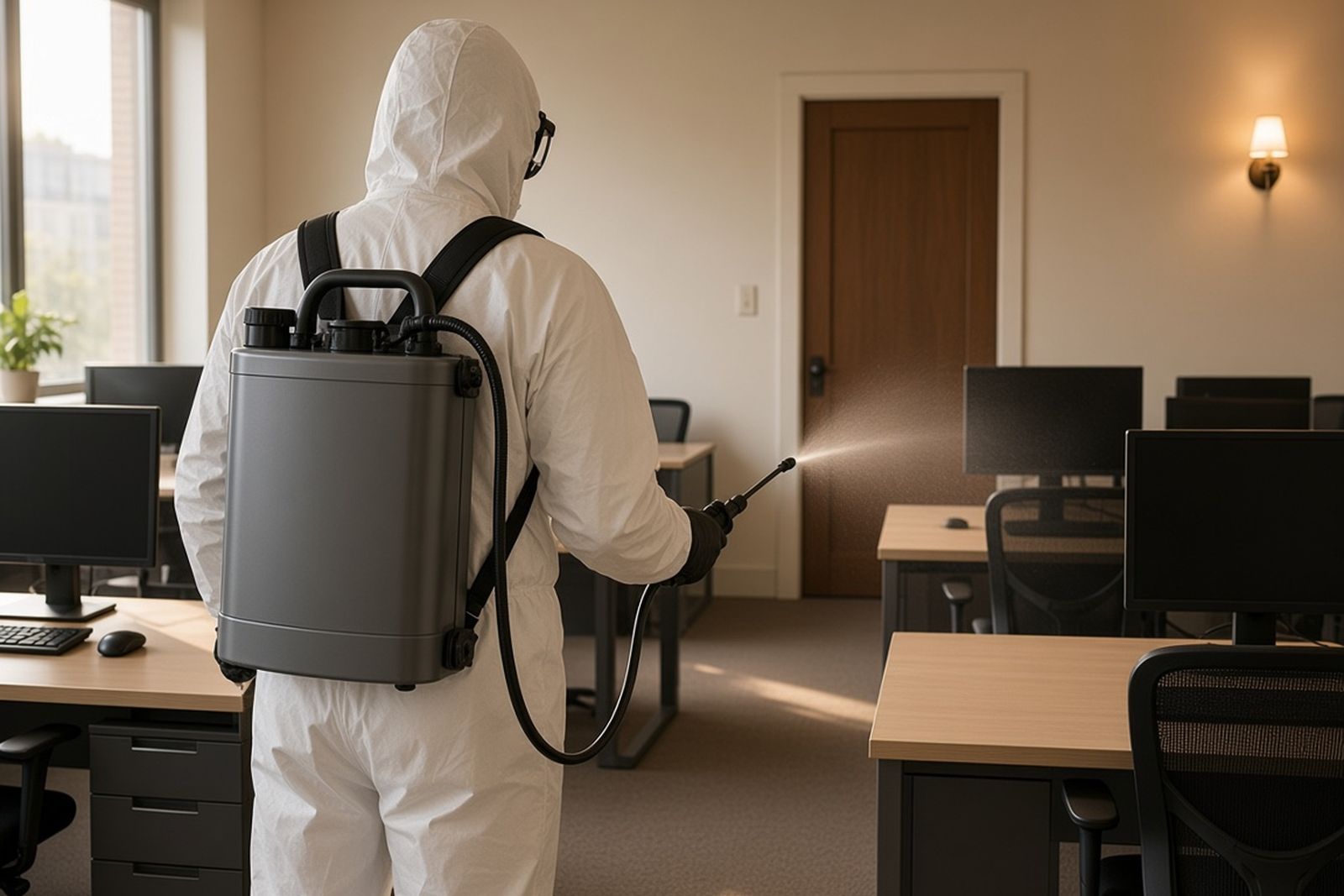
When a technician fogs a room, the space looks and smells treated. It is natural to assume that means it is clean. But fogging does not remove anything. It deposits droplets of a chemical onto surfaces. Dust, crumbs, fingerprints, grease, and dried spills are all still there when the mist settles.
That confusion matters because the effectiveness of a disinfectant depends heavily on what it lands on. A disinfectant applied to a dirty surface may be partly used up or blocked by the soil before it reaches the germs underneath.
Understanding the difference between cleaning, sanitizing, and disinfecting helps you judge any fogging proposal. It also helps you decide whether fogging is needed at all, or whether thorough cleaning and targeted wiping would do the job.
Smell can mislead as well. Many disinfectants leave a sharp or fresh scent that people associate with cleanliness. The scent tells you a product was used. It does not tell you whether surfaces were cleaned first, whether the right concentration was applied, or whether the product stayed wet long enough to work.
Cleaning, sanitizing, and disinfecting defined
These three terms are often used as if they were interchangeable. They describe different outcomes, and product labels use them carefully.
Cleaning removes visible dirt and organic material through physical action, usually with detergent, water, and wiping or scrubbing. It lowers the number of germs by taking away what they live in, but it is not designed to kill them.
Sanitizing reduces bacteria on a surface to levels considered safe by public health standards. Sanitizers are common in food service, where they are used on food-contact surfaces after cleaning.
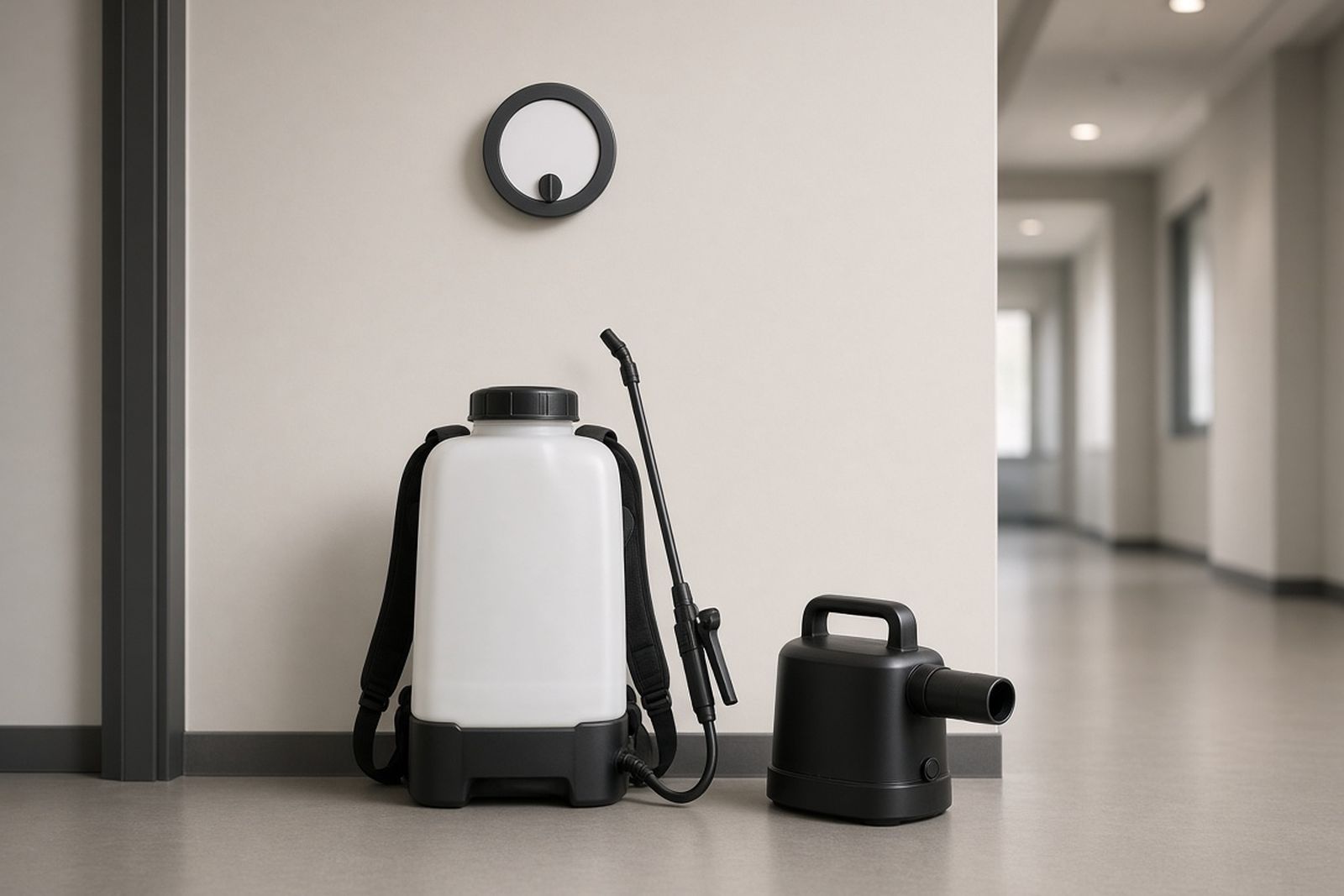
Disinfecting kills most of the viruses and bacteria listed on a product's label, when used as directed. Disinfectants generally have longer contact times and stronger claims than sanitizers. Fogging and electrostatic spraying are application methods for sanitizers or disinfectants, not separate categories.
- Cleaning: removes soil and organic matter.
- Sanitizing: lowers bacteria to safe levels, often on food-contact surfaces.
- Disinfecting: kills listed germs when label directions are followed.
- Fogging or electrostatic spraying: a way to apply a product, not a cleaning step.
Why does cleaning need to come first?
Most disinfectant labels call for cleaning heavily soiled surfaces before disinfecting. The reason is chemistry. Organic material such as food, grease, and bodily fluids can react with or shield germs from the active ingredient.
Research on no-touch methods shows how much pre-cleaning matters. In a 2023 study by Knobling and colleagues, manual wiping met the study's disinfection-success criterion on 98.1% of surfaces versus 75.5% for UV-C used without prior cleaning. That study compared wipes with ultraviolet light rather than foggers, but the underlying lesson carries over: a no-touch method applied to uncleaned surfaces tends to underperform.
Some surfaces also develop films that are hard to remove. Professionals increasingly talk about dry-surface biofilms, thin layers of microbes that can persist on dry surfaces. In a 2024 survey of healthcare professionals by Centeleghe and colleagues, 87.6% had heard of biofilms, but only 39.1% knew of dry-surface biofilms. Physical cleaning is the main way to disrupt them.
In practical terms, pre-cleaning does not have to be elaborate. Wiping down counters, tables, handles, and fixtures with detergent and water, and removing obvious debris from floors, gives any disinfectant a far better chance. The more soil a surface carries, the more important this step becomes.
Making the disinfection step work: product, concentration, contact time
Once surfaces are clean, a disinfectant still has to be applied correctly. Three factors matter most: the right product, the right concentration, and enough contact time.
The product must be registered for the germs of concern and labeled for the application method being used. The concentration must match the label, since too weak a mix may not work and too strong a mix adds hazard without benefit. And the surface must stay wet for the full contact time listed on the label.
When those conditions are met, electrostatic application can perform well in testing. A 2026 peer-reviewed laboratory study in Infection, Disease and Health found that electrostatic spraying of 2% hydrogen peroxide with a 10-minute contact time achieved more than a 6-log reduction of E. coli on 16 surface types. That was a controlled lab study with a specific product and contact time, which is exactly the point: results depend on following the conditions.
Fogging and electrostatic spraying often produce fine droplets. Fine droplets can dry quickly, especially in warm, dry rooms or on surfaces with strong air movement. If the surface dries before the contact time is reached, the disinfectant may not have finished its work.
Experienced technicians account for this. They adjust the device, move at a steady pace, pay attention to room conditions, and sometimes apply a second pass to keep surfaces wet long enough. They also know which surfaces tend to be missed, such as the undersides of tables and the backs of chairs.
If a provider cannot tell you the contact time for the product it plans to use, or suggests that a light mist is enough regardless of the label, the disinfection step may be incomplete.
Humidity, temperature, and air movement all change how long a surface stays wet. Turning off fans and air handlers during application, when the label and building systems allow it, can help droplets settle and remain on surfaces instead of drifting or evaporating.
The right order for a typical job
A careful sanitization job follows a clear sequence, whether it involves a single room or a whole building. Your state pesticide regulatory agency or licensing agency can say whether licensing or notification requirements apply to disinfectant application in your type of facility.
- Identify the reason for treatment and the germs of concern.
- Remove or protect food, dishes, toys, and sensitive items.
- Clean visibly soiled surfaces and high-touch areas with detergent or cleaner.
- Clean up any bodily fluids first with appropriate protective equipment.
- Select a disinfectant registered for the germs and labeled for the application method.
- Apply it at the correct dilution, keeping surfaces wet for the full contact time.
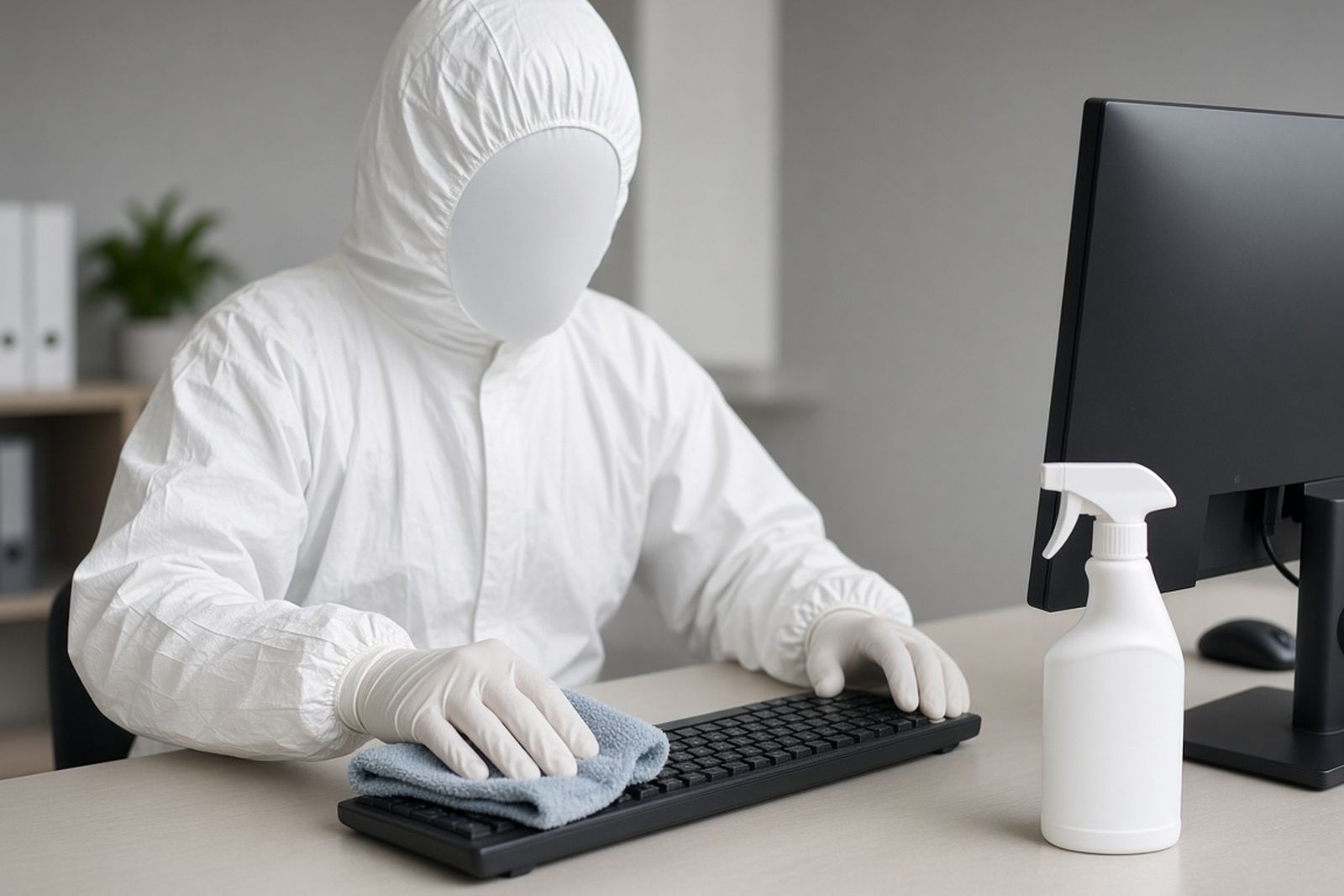
- Wipe by hand any high-touch items the spray may not fully reach.
- Keep the space empty for the label's re-entry time and ventilate as directed.
- Rinse food-contact surfaces afterward if the label requires it.
- Document the product, dilution, areas treated, and times.
When is fogging not the right tool at all?
Sometimes the best recommendation is to skip fogging. If the concern is a single contaminated area, such as a bathroom after a stomach illness, focused cleaning and disinfection by hand usually does better than treating the whole building.
Fogging is also a poor match for surfaces that are heavily soiled, porous items such as upholstered furniture, and spaces that cannot be vacated. In those situations, cleaning, laundering, or targeted wiping are more appropriate.
A knowledgeable provider will tell you when fogging adds little value. That kind of honest advice is a sign of expertise, not a lack of it.
Electronics are another case for caution. Keyboards, touchscreens, and control panels may not tolerate mist, and many manufacturers recommend specific wipes instead. Covering or hand-treating these items protects both the equipment and the effectiveness of the disinfection.
Example: a restaurant after a norovirus scare
The following example is illustrative. A small restaurant learns that two employees were out with a stomach illness, and the owner wants the dining room and kitchen treated before reopening the next day.
The provider begins with cleaning. Staff and technicians remove food, wash and sanitize dishes, and clean counters, prep tables, door handles, and restroom fixtures with detergent. A restroom where an employee was sick is cleaned and disinfected by hand with an appropriate product.
Next, the technician uses an electrostatic sprayer with a disinfectant labeled for that method and for the germs of concern, keeping surfaces wet for the full contact time. Chair backs and menu holders are wiped by hand. The restaurant stays closed for the label's re-entry time, and food-contact surfaces are rinsed afterward as the label requires.
The owner receives a record of each step. If the provider had simply fogged the space without cleaning first, the counters and restroom surfaces most likely to spread illness would have been treated least effectively.
Questions to ask a provider about the distinction
Ask whether cleaning is included and, if not, who will do it before the provider arrives. Ask which product will be used, whether it is labeled for fogging or electrostatic application, what germs it is registered against, and what the contact time is.
Ask how the technician handles high-touch surfaces that the spray may not reach, and whether food-contact surfaces need rinsing afterward. Ask what documentation you will receive.
A provider that explains how cleaning and disinfection work together, and treats fogging as one step rather than the whole solution, is giving you the most reliable path to a space that is truly cleaner and safer.
Sources
- Knobling et al. — Superiority of manual disinfection using pre-soaked wipes over automatic UV-C without prior cleaning
- Centeleghe et al. — Infection prevention control in practice: a survey of healthcare professionals' knowledge and experiences
- Infection, Disease & Health — Comparative study of the performance of the manual backpack sprayer and the advanced handheld electrostatic disinfection device for the sanitization of inanimate surfaces